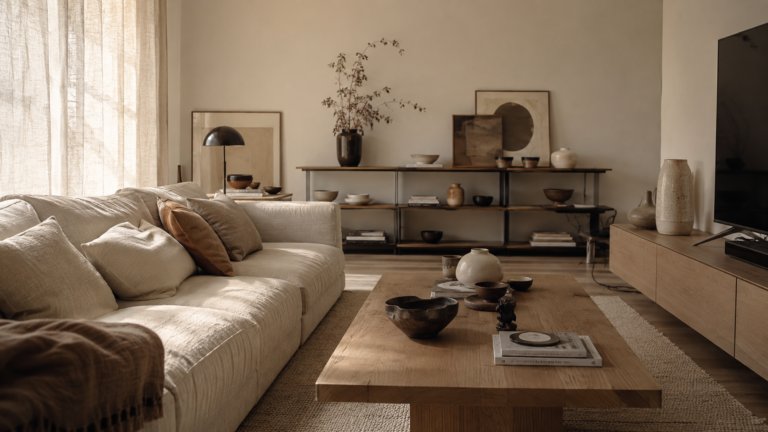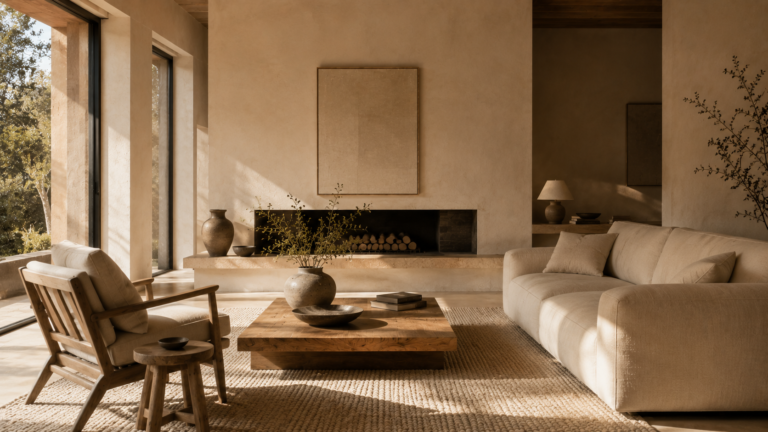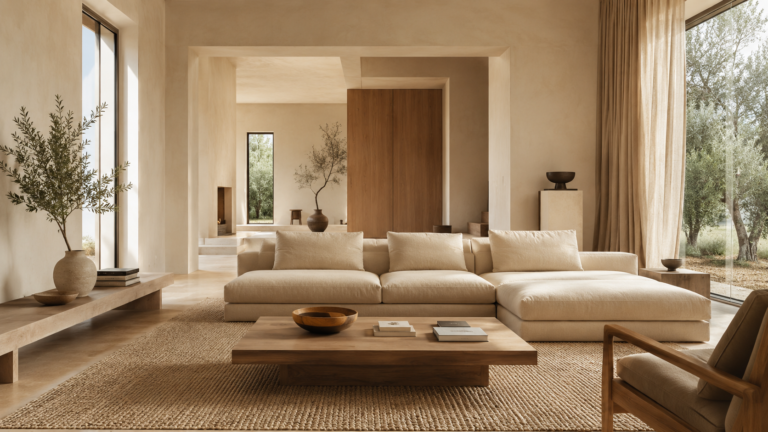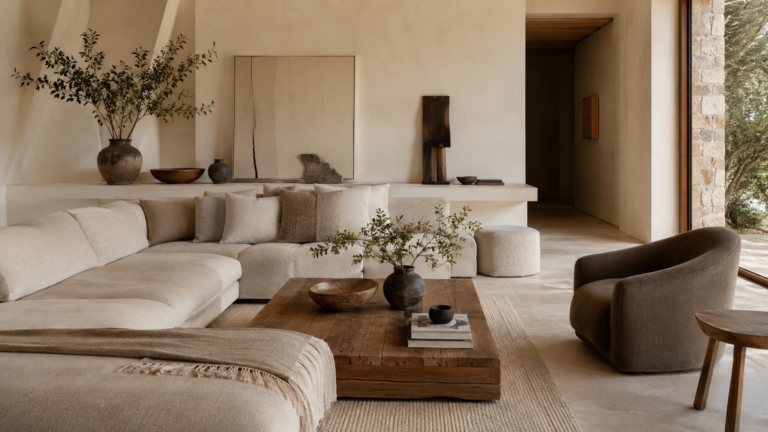
Warm Minimalist Bedroom Ideas: Make It Cozy, Not Cold
A minimalist bedroom usually feels cold for three fixable reasons: cool toned neutrals, too little texture, and one harsh overhead light. Fix those three and you keep every clean line you love while the room finally feels like somewhere you want to sleep. These warm minimalist bedroom ideas start with a quick diagnosis, so you only spend money on the problem you actually have.
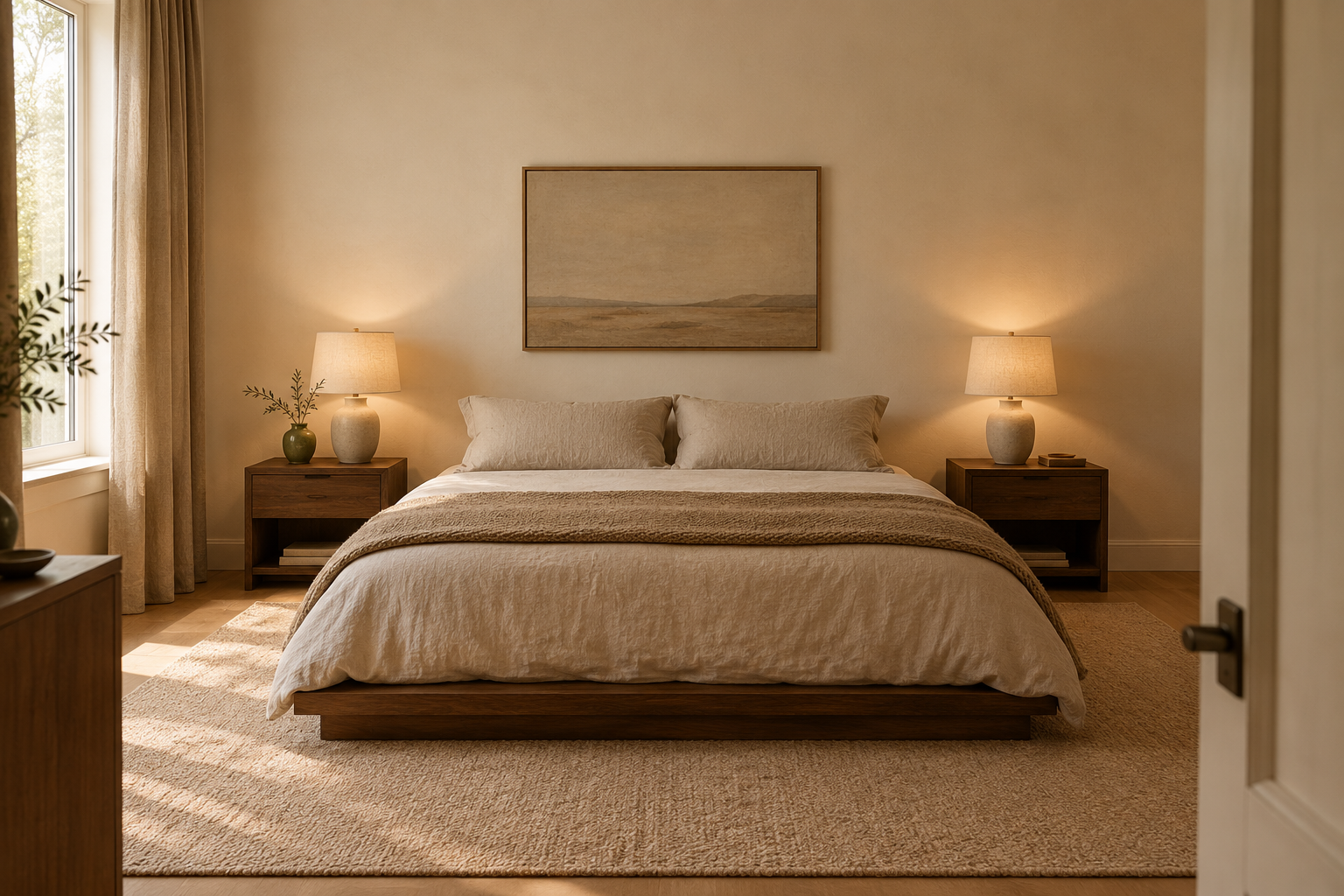
Quick answer: A warm minimalist bedroom uses warm white or greige walls, at least three different textures such as linen, wool and wood, and light from several low sources at about 2700K instead of one ceiling fixture. Start with bedding and a rug, then fix the lighting, then add one accent color.
Table of Contents
Why a Minimalist Bedroom Feels Cold: The Three Causes
Your bedroom feels cold because of three things working together: neutrals that lean blue or grey, surfaces that all feel the same under your hand, and a single ceiling light that flattens everything at night. Any one of these is manageable. All three together turn a clean room into a waiting room.
Cause 1, cool toned neutrals. Many whites and greys carry a blue, green or grey base. In daylight they look crisp. In the evening, under a lamp, they look institutional.
Cause 2, no texture. When paint, sheets, curtains and furniture are all smooth and matte, the eye has nothing to rest on and your hand gets no signal of comfort.
Cause 3, one overhead light. A single ceiling fixture throws light straight down, casts hard shadows and leaves the walls dark, so the room looks smaller and sharper than it is.
Myth: a minimalist bedroom has to be nearly empty. Reality: minimal describes shapes and palette, not item count. A room with a layered bed, a rug, two lamps, a chair and a nightstand can still read as minimal when the lines are simple and the color range is narrow. Emptiness is what makes a room cold. Restraint is what makes it calm.
Next, a way to find out which of the three is actually your problem.
The Cold Room Check: A Three Question Test Before You Buy Anything
Score your room on three questions: color temperature, texture count and light sources. Whichever one fails is where your first purchase goes. This is the Cold Room Check, and it takes about five minutes.
Question 1, color temperature. Hold a sheet of plain white printer paper against your wall, then against your bedding. If either one looks greyer, bluer or greener than the paper, your neutrals run cool. If they look slightly creamier, sandier or pinker, they run warm. Pass: wall and bedding both look a little warmer than the paper.
Question 2, texture count. Sit on the bed and count the different surface feels you can see or reach, for example smooth paint, cotton sheets, a knit throw, wood grain, a woven rug, linen curtains. Pass: four or more. Fail: two or fewer. Treat four as a working rule of thumb, not a law.
Question 3, light sources. At night, switch off the ceiling light and count what is still glowing. Pass: at least two lamps or sconces at different heights, each with a warm bulb. Fail: one source or none.
How to read your score. One fail means you fix that one thing first. Two or three fails means you work in this order: light first because it is the cheapest and fastest, then textiles, then wall color.
Illustrative example, not a real case: picture an 11 by 12 foot (about 3.3 by 3.7 m) bedroom with white walls, grey bedding, grey curtains and one ceiling light. Temperature fails, because the grey bedding looks blue beside the paper. Texture fails, because the room offers only smooth paint and smooth cotton. Light fails, because there is one source. The fix order is: swap the ceiling bulb for a 2700K one and add a lamp on each side of the bed, replace the grey bedding with oatmeal linen plus a knit throw, add a wool rug, and only repaint if the walls still read cold. The result is three light sources and five textures without touching a single piece of furniture.
Warm Minimalist Bedroom Color Palette: Walls, Bedding and Wood
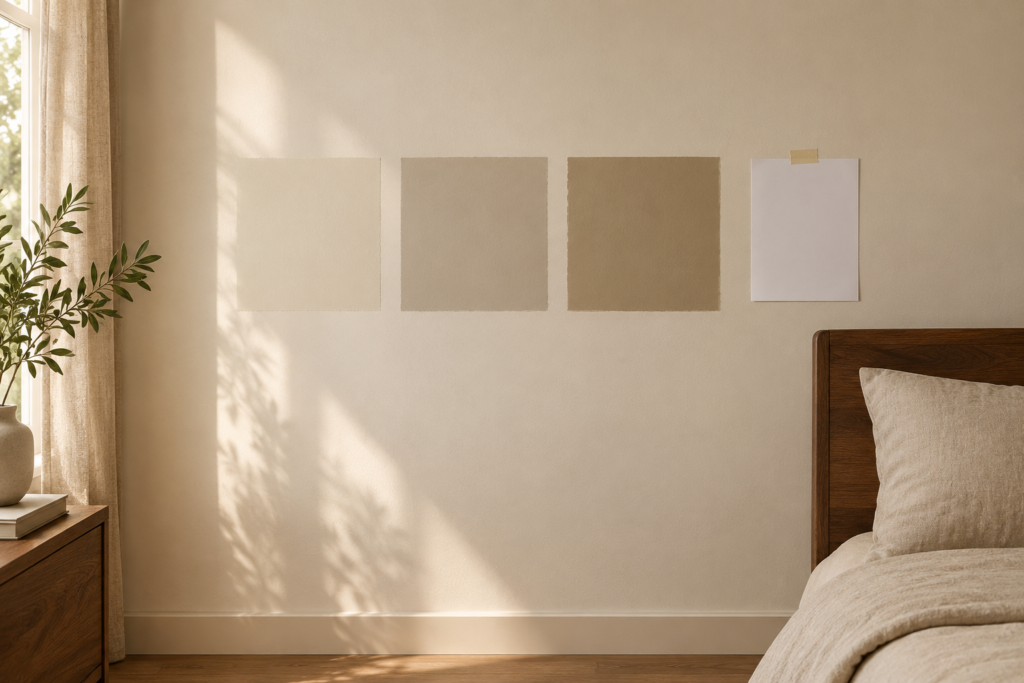
For most bedrooms the safest warm palette is a warm white wall, oatmeal or khaki bedding and one wood tone. Greige also works, but only after you test it. Here is how the three wall options compare.
Option: Warm white. Best for: small or dim rooms and anyone who wants the brightest look. Watch out for: whites with too much yellow turn custard colored under warm bulbs, so choose a soft cream rather than a buttery one.
Option: Greige. Best for: larger rooms with good daylight. Watch out for: a greige with a green or blue base reads cold on cloudy days and in the evening.
Option: Khaki and sand tones. Best for: bedrooms that need depth and get plenty of light. Watch out for: dark khaki can swallow light in a small room, so use it on textiles before you use it on walls.
The white paper undertone test. Paint a sample at least two feet (about 60 cm) square on the wall, or on a board you can move around. Hold plain white paper beside it in morning light, then again in the evening with your lamps on. If the sample looks creamier, sandier or pinker than the paper both times, it is warm. If it turns grey, green or blue at either time, skip it. Judge the color on your wall, never on the lid or the small swatch card.
The same method works across your whole home, and it is covered in more depth in the guide to building a warm neutral palette.
Bedding and Rug: The Two Purchases That Change the Most
Buy bedding first, then the rug. Bedding costs less, changes the room faster and shows you whether your palette works before you commit to a bigger purchase. This is where a cozy minimalist bedroom is won or lost.
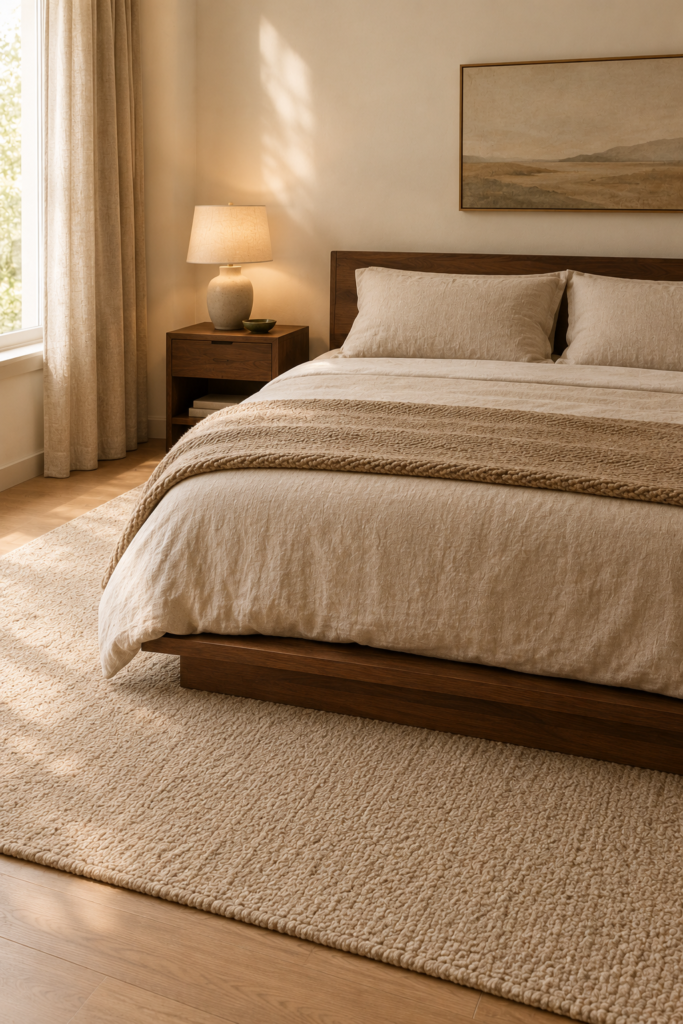
Build two soft layers. The base layer is a washed linen or cotton duvet cover in oatmeal, sand or warm white. The top layer is a throw or quilt in a different weave, folded across the foot of the bed. Contrast in texture does more than contrast in color here.
Expect a wide spread in cost. A good linen duvet cover often lands somewhere between 100 and 300 USD for a queen, and a quality throw between 40 and 120 USD, but brand, fabric and region change those numbers a lot.
Now the rug. Size it to the bed, not to the room. A common guideline is for the rug to extend about 18 to 24 inches (45 to 60 cm) past both sides and the foot of the bed, so the lower two thirds of the bed sits on it. As rough starting points, a queen bed often suits an 8 by 10 foot rug, a king bed an 8 by 10 or 9 by 12, and a twin a 5 by 8. Sizes vary by bed frame and room, so measure your own before you order.
Choose wool or a wool blend with a low pile in sand or oatmeal. Prices range from roughly 150 USD for synthetic rugs to well over 1,000 USD for hand knotted wool.
Here is the part most people skip. Before buying, mark the rug outline on the floor with painter’s tape and leave it for two days. If you trip on an edge or the tape crowds your door, you have just saved yourself a return.
Buying order: 1. Bulbs and bedding. 2. Rug. 3. Curtains, only if the window still looks cold after steps one and two.
Bedroom Lighting: Bulbs and Lamp Heights That Warm the Room
Good minimalist bedroom lighting comes down to warm bulbs at about 2700K, a lamp on each side of the bed and no reliance on the ceiling fixture. It is the cheapest change in this guide and often the most dramatic.
Kelvin is a color temperature scale where a lower number means a warmer glow. 2700K is the soft white of a traditional bulb. At 4000K and above, light looks like an office. Also check the color rendering index, often printed as CRI. A rating of 80 or higher keeps fabrics and wood looking natural, and 90 is better. Some people prefer an even warmer 2200K to 2400K bulb at the bedside for the last hour before sleep.
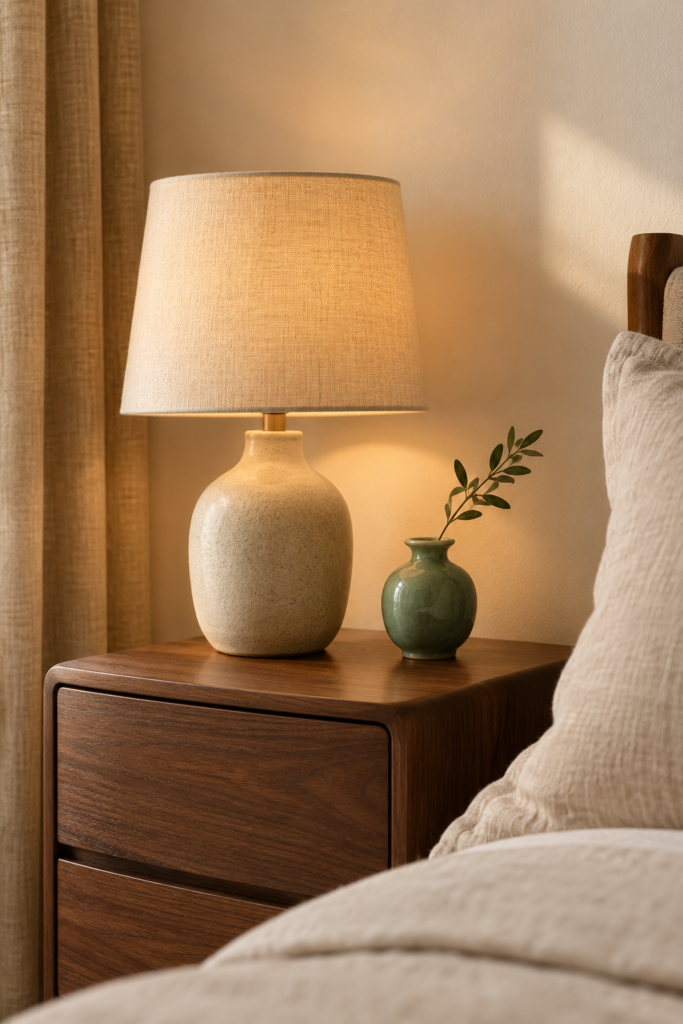
Lamp height matters as much as bulb color. When you sit up in bed, the bottom of the lampshade should sit at or just below eye level, so the bulb stays hidden and light falls on the pillow and wall instead of in your eyes. If your nightstand is about mattress height, commonly 24 to 28 inches (60 to 70 cm), a lamp around 20 to 28 inches (50 to 70 cm) tall usually works. Check it by sitting up.
Think in three levels. Level one is the bedside lamp on each side. Level two is one low extra source, such as a floor lamp in a corner or a wall sconce aimed at the wall. Level three is the ceiling light, kept on a dimmer or switched off in the evening. This is the idea behind layered lighting, which the earlier article on layered lighting explains in more detail.
Wood, Linen and One Accent: How to Bring In Color
Bring in color with three items only: khaki linen, a walnut or oak nightstand and one jade object. Anything more and the room stops being minimal.
Khaki linen. Use it for curtains or bedding. The slightly uneven weave catches light, which adds texture and color at once.
The nightstand. Walnut is deeper and often has a reddish or purple brown base. Oak is lighter, with a golden or beige base. Choose walnut if your room is bright and you want some grounding contrast. Choose oak if the room is small or north facing and you want to keep it light. Keep the bed frame, floor and nightstand within one or two wood tones, a point developed further in the guide to matching wood tones.
The jade object. Pick one: a small vase, a trinket dish, a ceramic lamp base. Jade sits between green and blue, and a small touch of it tends to make the surrounding warm neutrals look warmer by contrast. Place it at eye level on the nightstand. One means one. A second green object turns an accent into a theme.
Common Mistakes and What Each One Costs You
Most cold bedrooms trace back to the same handful of mistakes. Here is each one with its price and its fix.
Mistake: bulbs at 4000K or higher, often sold as daylight. Cost: beige reads grey and the glare is harsh before sleep. Fix: switch to 2700K.
Mistake: buying bedding before testing the wall color. Cost: clashing undertones and a return you did not plan for. Fix: hold a fabric swatch or the white paper against the wall first.
Mistake: a rug that is too small. Cost: the bed looks like it is floating, your feet land on cold floor and the room looks smaller. Fix: extend the rug 18 to 24 inches past the bed.
Mistake: three or more wood tones. Cost: the room looks busy, which undoes the calm. Fix: limit yourself to one or two.
Mistake: filling empty spots with decor. Cost: clutter, with no real gain in warmth. Fix: add texture instead of objects.
Mistake: trusting the paint card. Cost: repainting an entire room. Fix: test a two foot sample on the wall.
When this advice does not apply
Very small room. In a room under about 9 by 10 feet (2.7 by 3 m), a standard rug will not fit. Use a smaller rug under the lower third of the bed, or two narrow runners. Swap nightstand lamps for wall sconces to free up surface, and cap the room at three textures. These small minimalist bedroom ideas keep it airy.
North facing room. In the Northern Hemisphere, a north facing room gets cooler, bluer light all day, and in the Southern Hemisphere the same is true of a south facing room. Choose a warm white with a visible cream or pink base, avoid any greige with a green base, and turn on your lamps earlier in the day.
Renters. If you cannot repaint, put the effort into what you can move: bedding, curtains, a rug, plug in sconces and warm bulbs. These cover the three causes of a cold room, even if your walls stay white.
The Warm Bedroom Checklist (save this)
1. Paper test passed on both wall and bedding.
2. At least four textures within sight of the bed.
3. Every bulb at about 2700K with CRI 80 or higher.
4. A lamp on each side of the bed, shade near eye level when sitting up.
5. At least two light sources on at night.
6. Rug extends 18 to 24 inches past both sides and the foot of the bed.
7. One wood tone family and one accent color.
8. Nothing on the surfaces that has not earned its place.
Warm Minimalist Bedroom Ideas FAQ
How do I make a minimalist bedroom not cold and still keep it minimal?
Run the three question Cold Room Check, then fix only what fails. Most rooms need warm bulbs, one added texture layer and one warmer neutral, not more furniture. Count textures rather than objects, because texture adds warmth without adding clutter.
What is the best color palette for a warm minimalist bedroom?
Start with a warm white or soft cream on the walls, oatmeal or khaki on the bed and one wood tone. Limit the whole room to three or four colors. Test every wall color against white paper in both morning and evening light before you commit.
How can I make a small minimalist bedroom feel warmer?
Keep the palette to two or three close tones so the walls do not visually shrink the room. Hang curtains close to the ceiling, use wall sconces instead of bulky lamps and choose a rug that fits the lower third of the bed. Lift the bed on slim legs if the frame allows it, so floor shows underneath.
What bulb color works best for minimalist bedrooms?
About 2700K for general use, and a 2200K to 2400K bulb at the bedside if you like a dimmer wind down. Check the Kelvin number printed on the packaging, because the words warm white are not standardized across brands. Pair the bulbs with a dimmer if you can.
How much does it cost to warm up a minimalist bedroom?
A basic refresh of bulbs, a duvet cover and a throw can sit in the low hundreds of USD. Adding a wool rug and two lamps usually pushes it towards the high hundreds. Prices vary widely by brand, material and country, so set a budget per item before you shop.
Your Next Step: Run the Cold Room Check Tonight
The key decisions are simple. Fix light first, then bedding, then the rug, then add a single accent. Keep the palette warm, the textures varied and the object count low.
Tonight, turn off the ceiling light, count what is still glowing, and hold a sheet of white paper against your wall. That ten minutes will tell you exactly where to spend first.
This article is written to help readers plan a warmer minimalist bedroom. Paint, fabrics and lighting look different in every home, so test samples in your own room and verify sizes and prices before you buy.