The Touch Test: Bringing Organic Textures and Tactile Comfort into Minimalist Rooms
A minimalist room can look beautiful and still feel strangely cold.
The furniture is right. The palette is right. The proportions are right.
And yet, something feels missing.
You walk into the room and everything looks polished, controlled, and intentional. But there is very little that makes you want to reach out and touch it.
That is often the difference between a minimalist room that simply looks good and one that actually feels good to live in — the difference between a cold minimalist interior and a warm, tactile minimalist home.
The answer isn’t necessarily more furniture, more decoration, or more color.
It may simply be organic texture.
The soft irregularity of linen. The grain of natural oak. The cool surface of stone. The weight of wool beneath your feet. The imperfect edge of a handmade ceramic.
These small sensory details give a minimalist interior depth without taking away its calm.
This is the idea behind the touch test.
If you couldn’t see your room for a moment, would the natural materials around you still make it feel warm, comfortable, and inviting?
Because the next evolution of minimalist home design isn’t necessarily about adding more.
It’s about experiencing more from less.
Table of Contents
Why Minimalist Rooms Can Feel Empty
Minimalism has always been associated with visual restraint.
Clean lines.
Simple furniture.
Open space.
Neutral colors.
And there is something undeniably beautiful about that restraint.
But there is a point where simplicity can become sameness.
When every surface is smooth, every object is perfectly finished, and every material has a similar visual character, a room can start to feel flat.
The eye has nowhere to pause.
There are fewer subtle differences to discover.
Compare a polished wood surface with unfinished oak.
Place a soft linen curtain beside a hard plaster wall.
Put a thick wool rug over a smooth stone or timber floor.
Suddenly, the room has another dimension.
Nothing has necessarily been added for decoration.
The materials themselves are creating the interest.
This is one of the foundations of warm minimalism: allowing natural materials and tactile surfaces to create richness while keeping the overall composition restrained.
The Touch Test: A Simple Way to Read Your Room
Here’s a simple exercise you can try today.
Stand in the doorway of your room.
Look around as you normally would.
Then imagine that you couldn’t see anything.
What would you want to touch?
Would there be something soft?
Something rough?
Something warm?
Something cool?
Something naturally irregular?
Something that feels good beneath your hand?
Now open your eyes and look around again.
If almost everything in the room is smooth, hard, glossy, or visually identical, you’ve probably found the missing layer.
The touch test isn’t about literally touching every surface.
It’s a way of thinking about tactile variety in minimalist interior design.
A thoughtfully designed minimalist interior should have a quiet conversation between contrasting materials.
Hard and soft.
Smooth and rough.
Warm and cool.
Matte and reflective.
Structured and relaxed.
That contrast creates visual rhythm without requiring more clutter.
“Often, a lack of tactile variety is the hidden reason why your minimalist living room still feels messy even after you clear away physical items.”
And that is precisely what makes organic texture so powerful in minimalist home design.
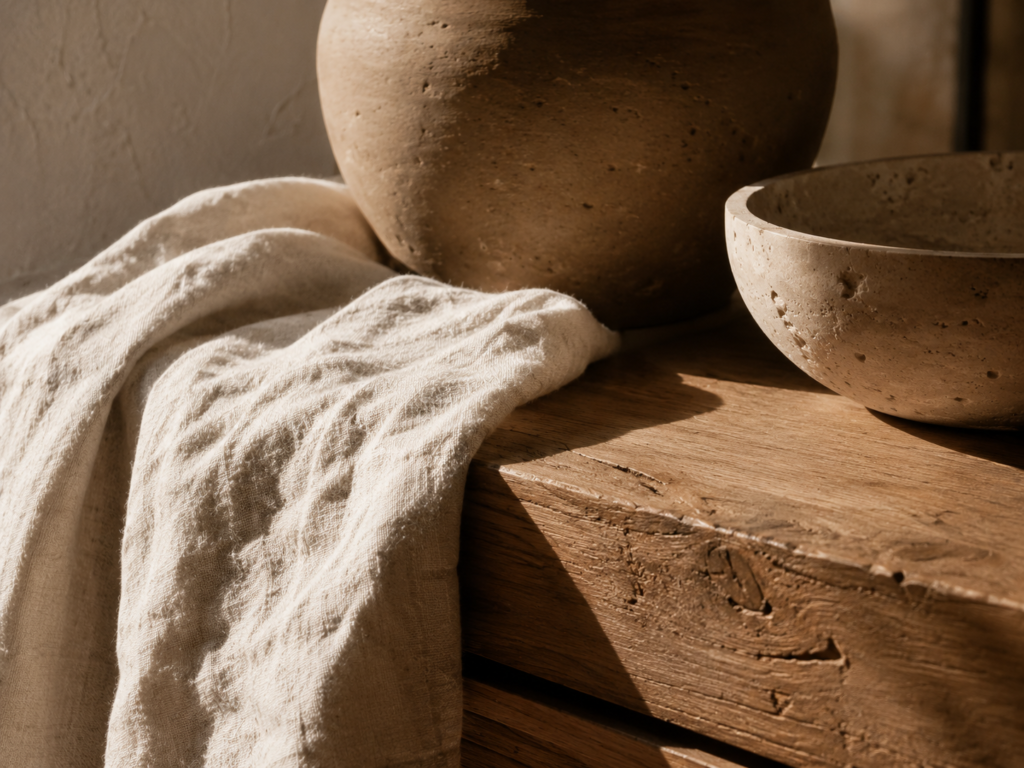
The Five Textural Layers of a Warm Minimalist Room
You don’t need dozens of different materials to create a tactile interior.
In fact, using too many competing textures can make a minimalist room feel visually confused.
Instead, think in layers.
Choose a few natural materials and allow each one to perform a different role.
Soft Textiles
Start with the materials that make a room physically comfortable.
Linen.
Cotton.
Wool.
Bouclé.
Washed fabrics.
A linen sofa immediately feels different from a tightly woven synthetic one.
A wool throw introduces warmth.
A textured cushion gives the eye somewhere softer to rest.
The important thing is subtlety.
Warm minimalist interiors rarely need loud patterns to create interest.
A beautifully woven fabric can be enough.
Natural Wood
Few materials bring warmth into a minimalist interior as naturally as wood.
But the finish matters.
Highly polished wood can feel formal and sleek.
Lightly finished oak feels softer.
Reclaimed or naturally irregular timber introduces even more character.
When choosing wood for a minimalist room, look for visible grain, natural variation, and finishes that allow the material to look like itself.
The goal isn’t to make the wood perfect.
The goal is to let it be present.
Stone and Mineral Surfaces
Stone creates a beautiful contrast against softer materials.
Travertine.
Limestone.
Marble.
Slate.
Granite.
Even handmade ceramic can introduce a similar mineral quality.
Stone works particularly well in minimalist interiors because it adds visual weight without adding visual clutter.
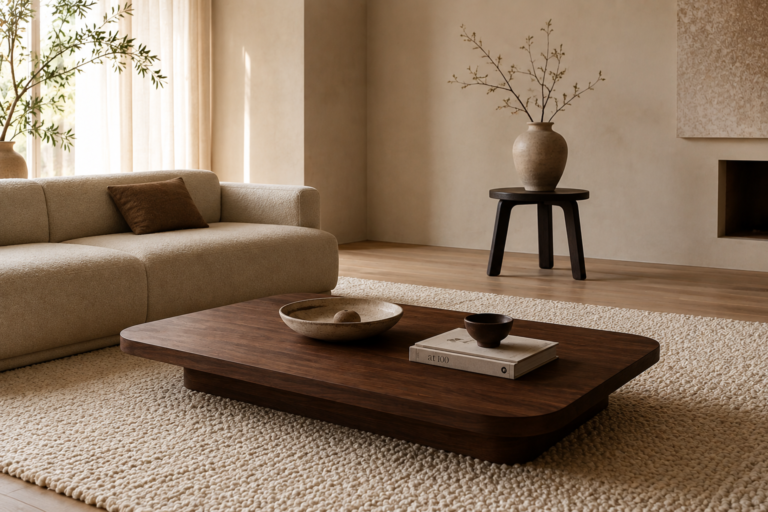
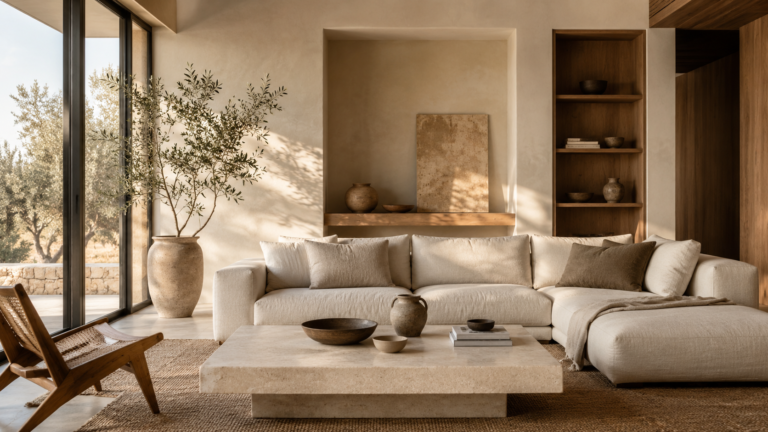
A travertine coffee table can ground an entire living room.
A limestone tray can give a console a subtle sense of depth.
A rough ceramic vessel can bring that same earthy quality to a much smaller surface.
Handmade Ceramics
This is where imperfection becomes an advantage.
A handmade ceramic doesn’t need to be perfectly symmetrical.
Its rim might be slightly uneven.
The glaze might vary subtly across the surface.
The shape may contain tiny inconsistencies.
Those details are what make it feel human.
In a minimalist room where most things have been carefully selected and precisely positioned, one imperfect object can create an important sense of warmth.
Woven and Natural Fibers
Jute.
Rattan.
Rush.
Seagrass.
Woven wool.
These materials create texture through repetition.
Their surfaces contain hundreds of tiny variations that add visual interest without introducing strong color.
A woven basket beside an oak cabinet.
A natural fiber rug beneath a linen sofa.
A rattan chair beside a stone table.
The effect is subtle, but it changes the atmosphere of the room.
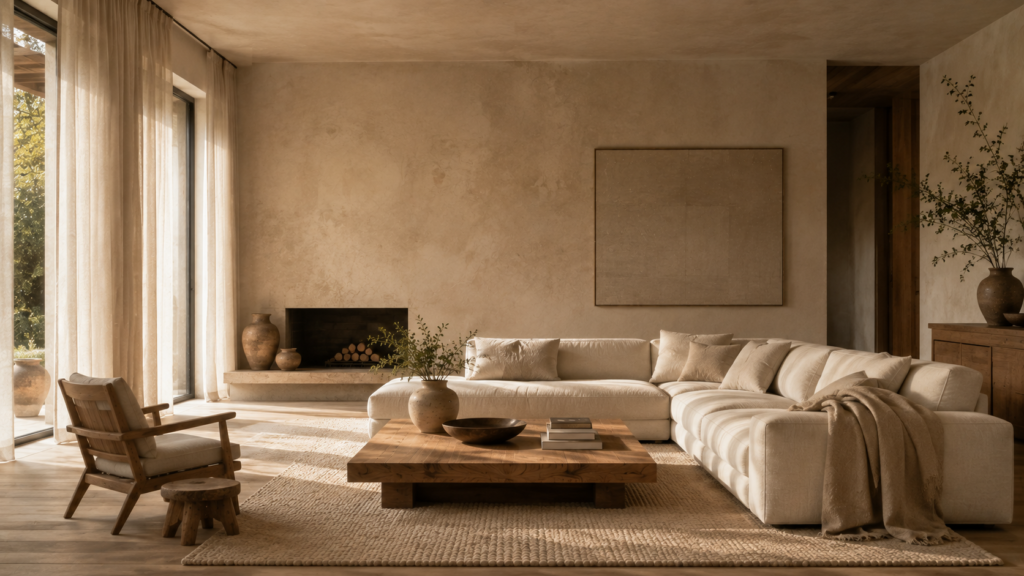
Start With the Largest Surfaces
One of the easiest mistakes in minimalist decorating is focusing on small objects while ignoring the largest surfaces in the room.
A beautiful ceramic bowl won’t completely transform a space if the sofa, floor, curtains, and walls are all visually flat.
Start with the things that occupy the most space.
The rug.
The sofa.
The curtains.
The walls.
The flooring.
The bed.
These are your primary textural layers.
A large wool rug can soften an entire living room.
Linen curtains can take the edge off large architectural windows.
A textured plaster wall can create depth without adding a single decorative object.
A relaxed linen sofa can make a minimalist interior feel considerably less formal.
A useful rule:
Texture has more impact when it is introduced at scale.
Let Materials Do the Decorating
This may be one of the most useful shifts you can make when designing a warm minimalist home.
Instead of asking:
“What decoration does this room need?”
Ask:
“What material is missing?”
Maybe the room has too many hard surfaces and needs something soft.
Maybe the palette is entirely matte and needs a subtle reflective element.
Maybe the room is dominated by warm wood and needs a cooler mineral surface.
Maybe the furniture feels visually heavy and needs something woven to break it up.
This approach naturally prevents overdecorating.
A linen throw can become decoration.
A beautiful stone bowl can become decoration.
The grain of an oak table can become decoration.
A textured plaster wall can become decoration.
When the materials are beautiful enough, you don’t have to cover them with things.
The room starts decorating itself.
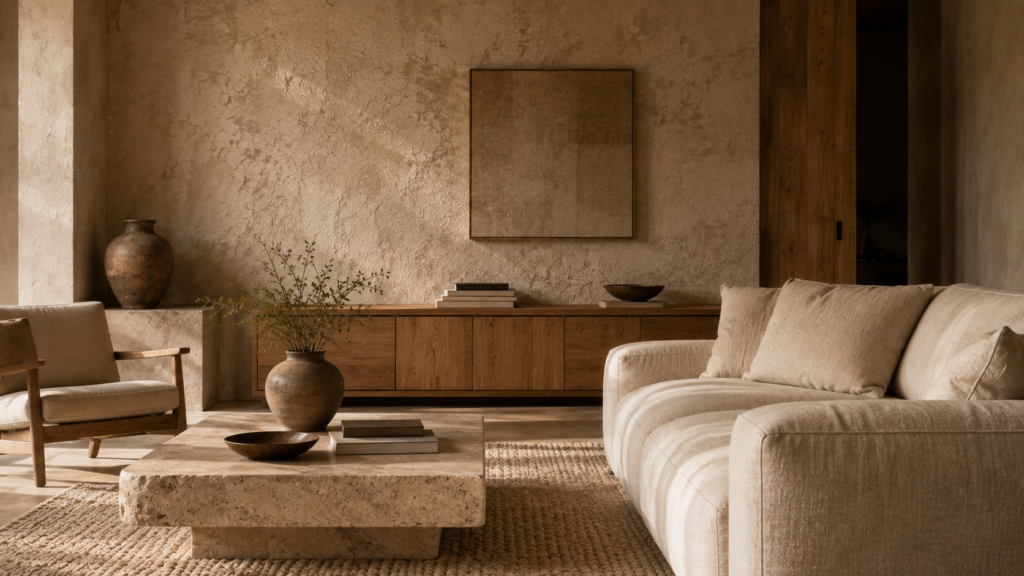
Build Contrast Without Creating Clutter
Texture works because of contrast.
But contrast doesn’t mean chaos.
You don’t need ten different materials competing for attention.
Try pairing a few opposing qualities.
Soft linen against hard stone.
Rough plaster beside smooth wood.
Wool against oak.
Matte ceramic beside glass.
Woven fibers against clean architectural lines.
These combinations create tension without creating visual noise.
Think of it as a conversation.
One material speaks softly.
Another answers.
A third creates a pause.
The room stays calm because the color palette remains restrained, even though the surfaces are varied.
This is one of the quiet secrets behind sophisticated, organic modern interiors.
The richness doesn’t come from having more things.
It comes from creating better relationships between the things you already have.
The Warm Minimalist Material Palette
If you’re starting from scratch, simplify the decision-making process.
Build around a small group of natural materials.
Natural wood.
Linen.
Wool.
Stone.
Ceramic.
That alone is enough to create an incredibly layered interior.
From there, introduce smaller amounts of materials such as leather, cotton, rattan, glass, brushed metal, or textured plaster.
The key is repetition.
If oak appears on the coffee table, let it appear somewhere else.
If linen appears on the sofa, repeat it through the curtains.
If stone appears on the coffee table, echo that mineral quality with a smaller object elsewhere.
Repetition creates cohesion.
Variation creates interest.
A beautiful room needs both.
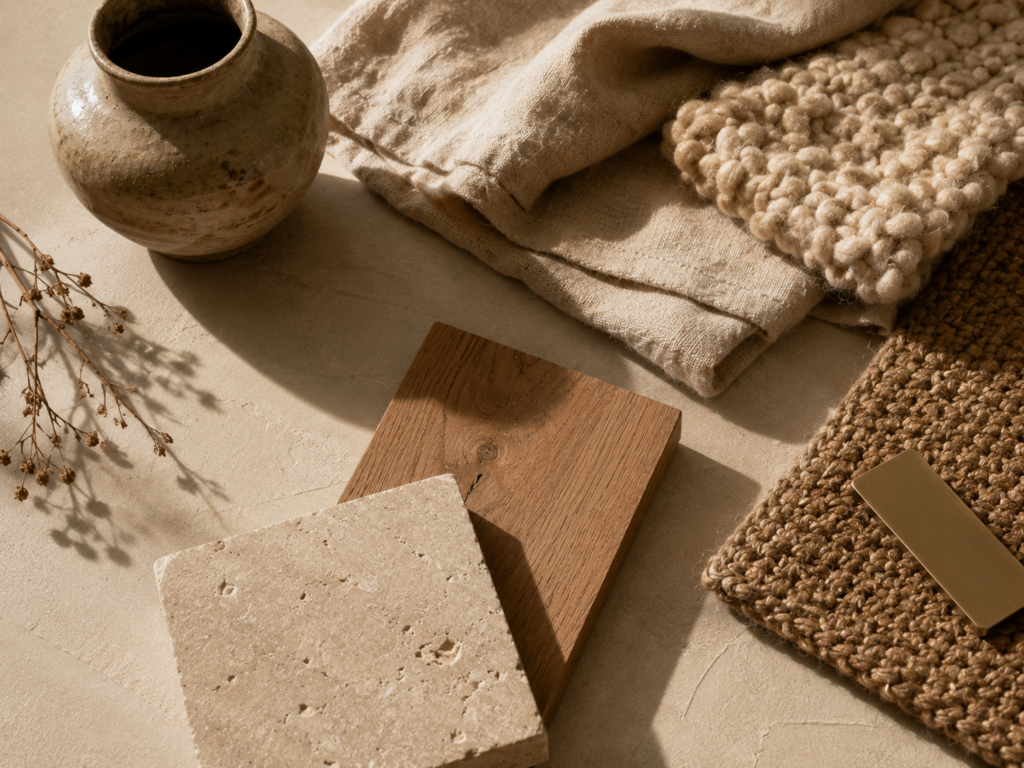
Don’t Be Afraid of Imperfection
There is something deeply comforting about objects that aren’t perfect.
A handmade bowl with a slightly uneven edge.
A wooden surface with a visible knot.
A linen cushion that has naturally creased.
A stone surface with subtle variation.
A woven basket that isn’t perfectly symmetrical.
These details remind us that a room is not a showroom.
It is a place where materials are allowed to age, change, and be used.
This is particularly important in minimalist interiors because too much perfection can quickly become sterile.
You don’t need to make the entire room rustic.
You only need a few moments of natural imperfection to interrupt the precision.
Think of them as small reminders that someone made these objects and someone lives with them.
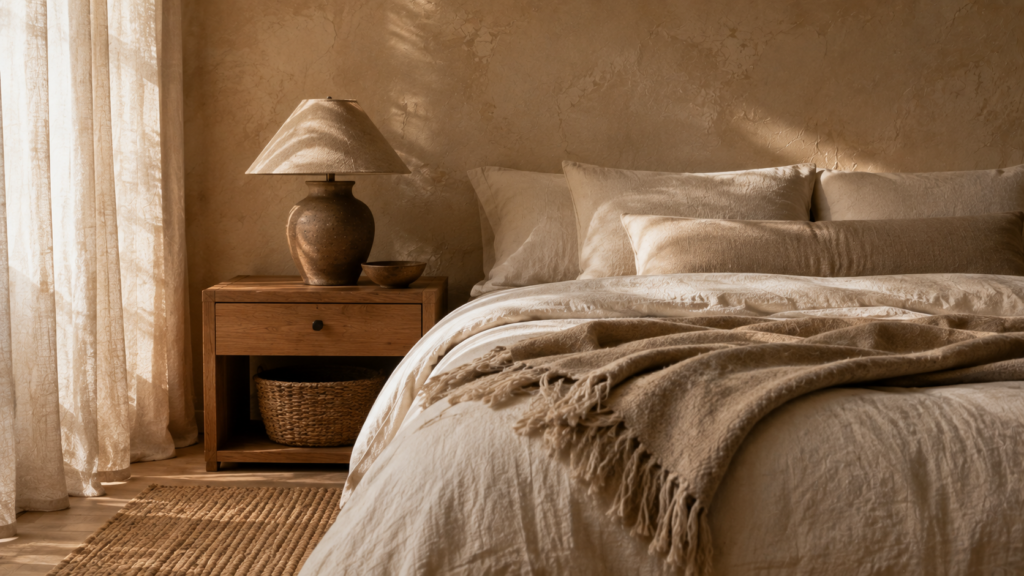
Let Linen Look Like Linen
Linen is one of the easiest ways to introduce tactile comfort into a minimalist interior.
But there is an important detail many people overlook.
Don’t be afraid of the wrinkles.
The creases are part of the beauty.
The slightly uneven surface is part of the beauty.
The relaxed drape is part of the beauty.
The way the fabric catches changing light is part of the beauty.
A linen sofa doesn’t need to look perfectly pressed.
A linen curtain doesn’t need to hang rigidly.
A bed doesn’t need to look permanently tucked into a hotel display.
Warm minimalism works best when materials are allowed to behave naturally.
The room can still be refined.
It just doesn’t have to feel untouchable.
Use Texture Where Your Body Meets the Room
Here’s a simple rule worth remembering:
Put tactile materials where your body naturally interacts with the room.
Think about your feet.
Your hands.
Your back.
Your arms.
These are the places where texture becomes an experience rather than simply a visual detail.
A soft rug beneath your feet.
A linen sofa beneath your hands.
A wool throw within reach.
A smooth wooden armrest.
A textured cushion.
A warm ceramic mug.
These small interactions are what make a room feel comfortable.
They turn interior design from something you look at into something you experience.
Texture Doesn’t Have to Mean Rustic
Organic texture is sometimes mistaken for rustic design.
They are not the same thing.
A room can use natural materials and still feel highly sophisticated.
The difference is in the editing.
A single rough limestone table in a clean architectural space can feel incredibly refined.
A softly textured plaster wall can feel contemporary.
A sculptural oak chair can feel elegant rather than rustic.
A handmade ceramic lamp can sit perfectly comfortably beside modern furniture.
The goal isn’t to make every object look handmade.
It’s to introduce enough natural variation to keep the space from feeling overly controlled.
That is the difference between organic minimalism and rustic maximalism.
One edits.
The other accumulates.
Create a Sensory Rhythm
Good interiors have rhythm.
You might not consciously notice it, but your eyes move from one surface to another.
Smooth.
Rough.
Soft.
Hard.
Warm.
Cool.
Matte.
Reflective.
That movement keeps the room from becoming visually monotonous.
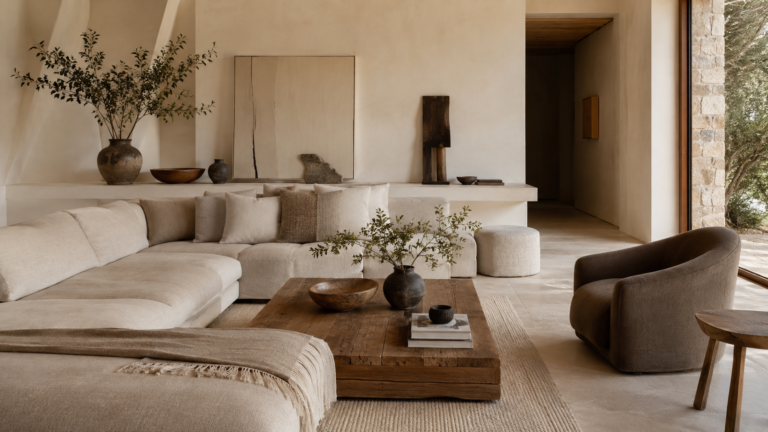
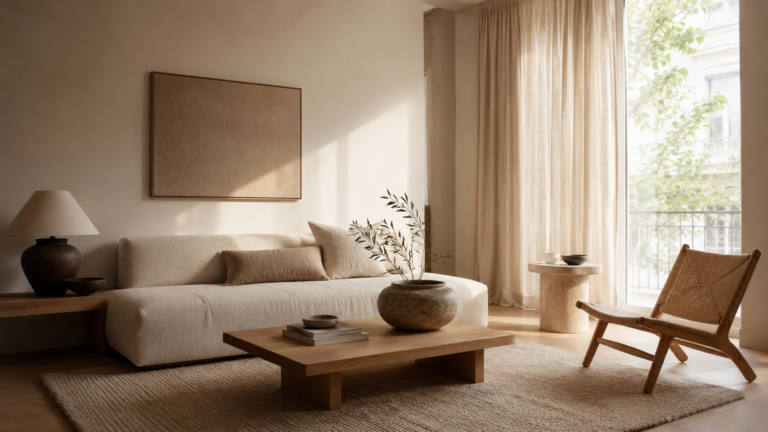
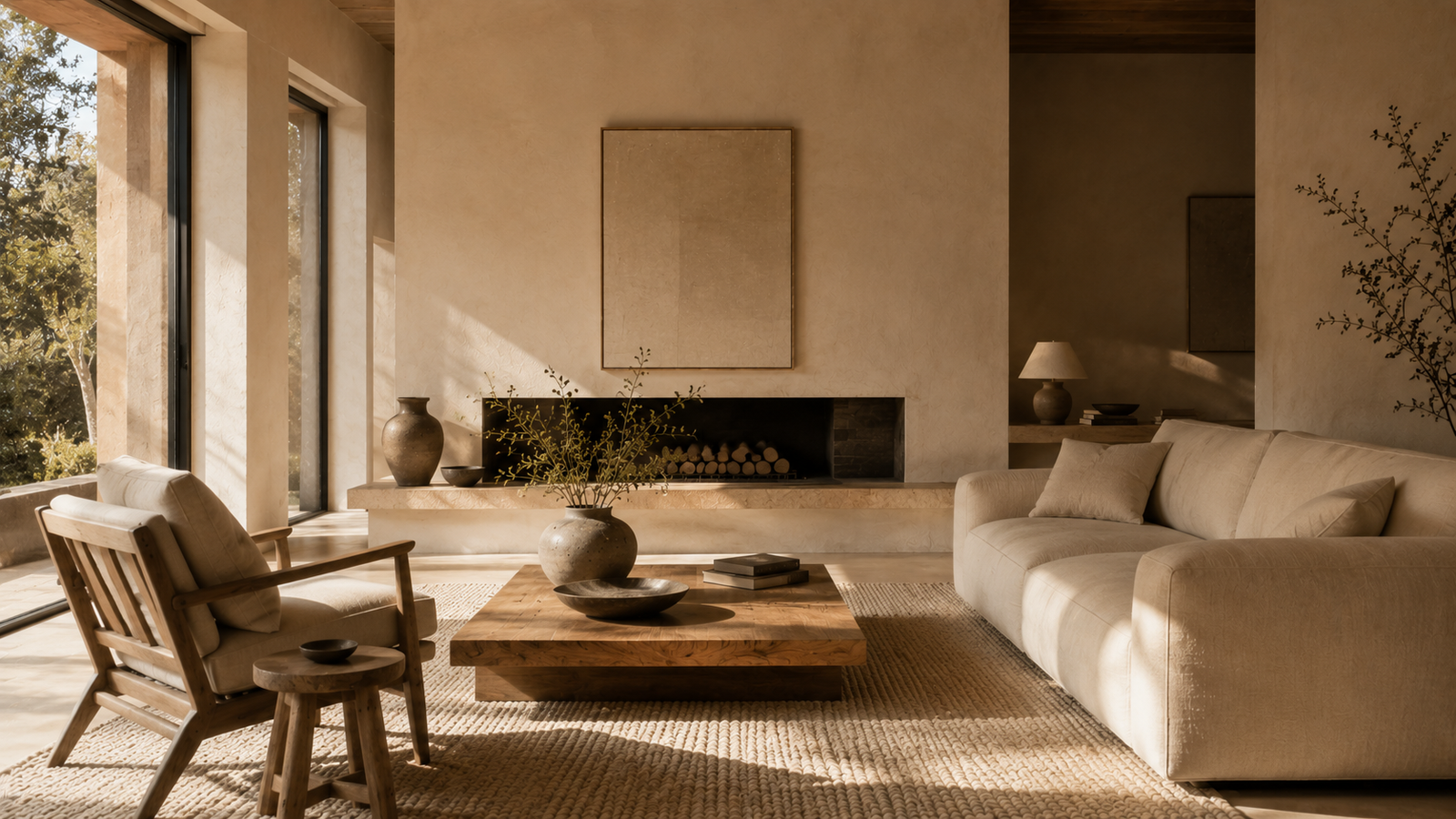
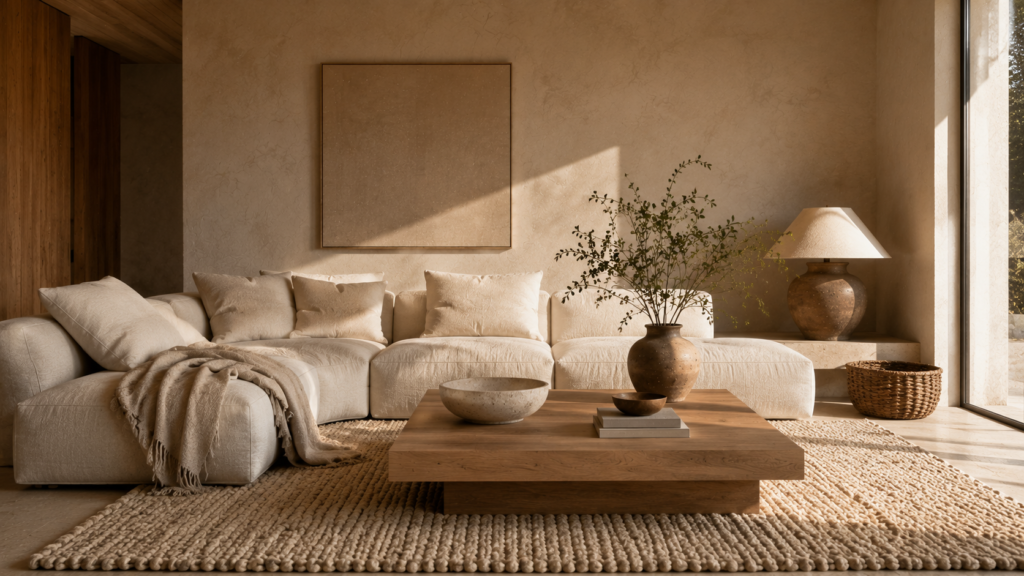
Imagine a living room with a soft linen sofa, a thick wool rug, a smooth oak table, a honed stone object, and a slightly glazed ceramic lamp.
“To elevate these tactile surfaces, pair them with layered ambiance and soft overhead alternatives.”
The colors could be almost identical.
Yet the room would still feel layered.
Why?
Because the materials are telling different stories.
This is why texture can sometimes be more powerful than color.
Color changes what you see.
Texture changes how you experience what you see.
The 60–30–10 Texture Rule
You don’t need a strict formula to design a tactile minimalist room, but a simple framework can help.
Think of the room as roughly:
60% dominant texture.
30% secondary texture.
10% accent texture.
For example, your dominant layer might be plaster, linen, and light wood.
Your secondary layer could be wool, stone, or darker wood.
Your accent layer could be handmade ceramic, aged leather, or woven fiber.
The percentages don’t need to be literal.
The idea is simply to avoid giving every texture equal visual importance.
One material should lead.
A few should support it.
One or two can provide the surprise.
What to Do When a Minimalist Room Feels Cold
Before buying anything new, look at the room differently.
Start with the floor.
Does it need something softer beneath your feet?
Look at the seating.
Does the fabric actually feel inviting?
Look at the windows.
Could linen curtains soften the architecture?
Look at the walls.
Are they completely flat, or could subtle plaster texture introduce depth?
Look at the coffee table.
Could wood or stone create a stronger natural contrast?
Then look at the smaller objects.
Are they all perfectly smooth and manufactured?
If several answers point in the same direction, the room may not need more furniture.
It may simply need more tactile contrast.
This is one of the most useful lessons in warm minimalist interior design:
When a room feels cold, look at the materials before you look at the shopping list.
The Touch Test in the Bedroom
The bedroom is perhaps the easiest place to understand tactile design.
It should feel comfortable before it even feels beautiful.
Start with the bed.
Layer natural fabrics instead of relying on patterns.
Linen sheets.
A cotton duvet.
A wool throw.
A few relaxed cushions.
Then introduce contrasting materials nearby.
A natural oak bedside table.
A handmade ceramic lamp.
A woven basket.
A small stone tray.
The color palette can remain almost entirely neutral.
The textures provide the richness.
And because the bedroom is fundamentally a sensory space, this approach feels natural rather than forced.
The Touch Test in the Living Room
In the living room, focus on the places where people naturally gather.
The sofa.
The rug.
The coffee table.
The armchair.
The lighting.
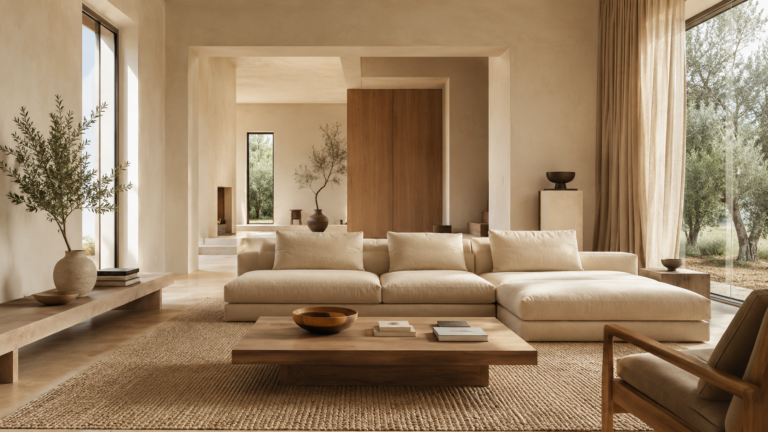
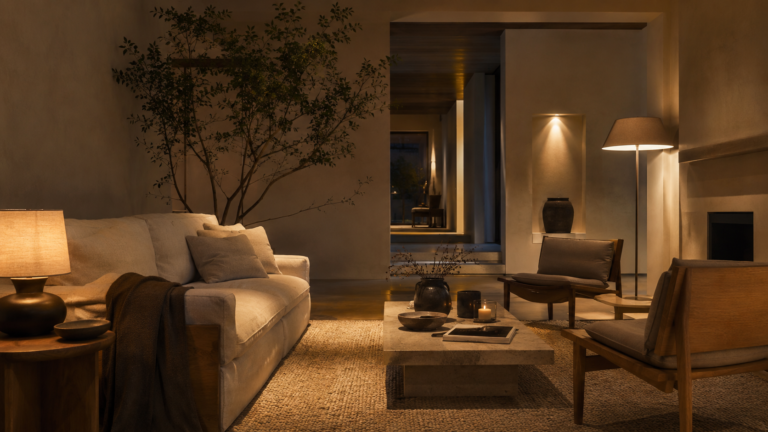
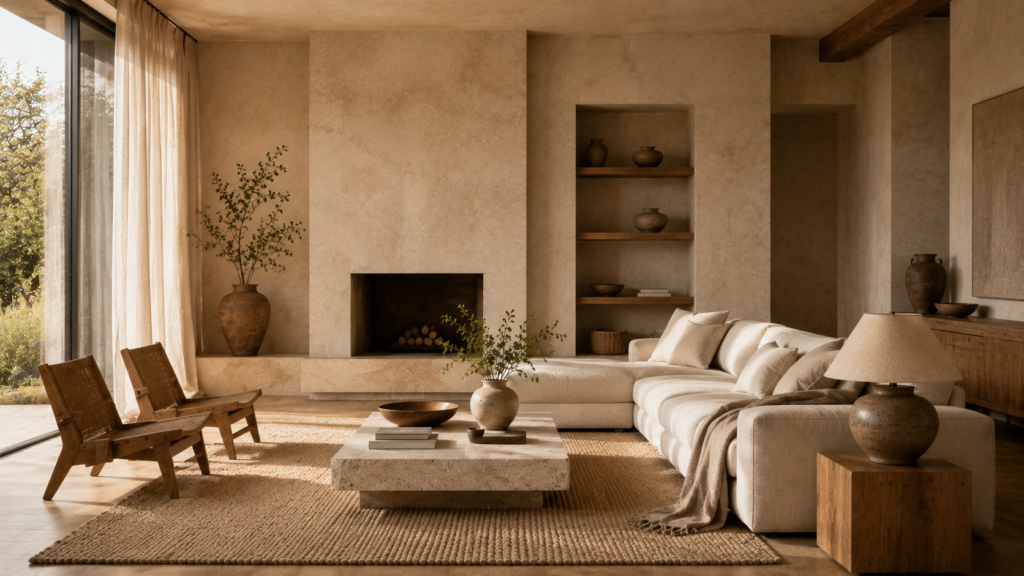
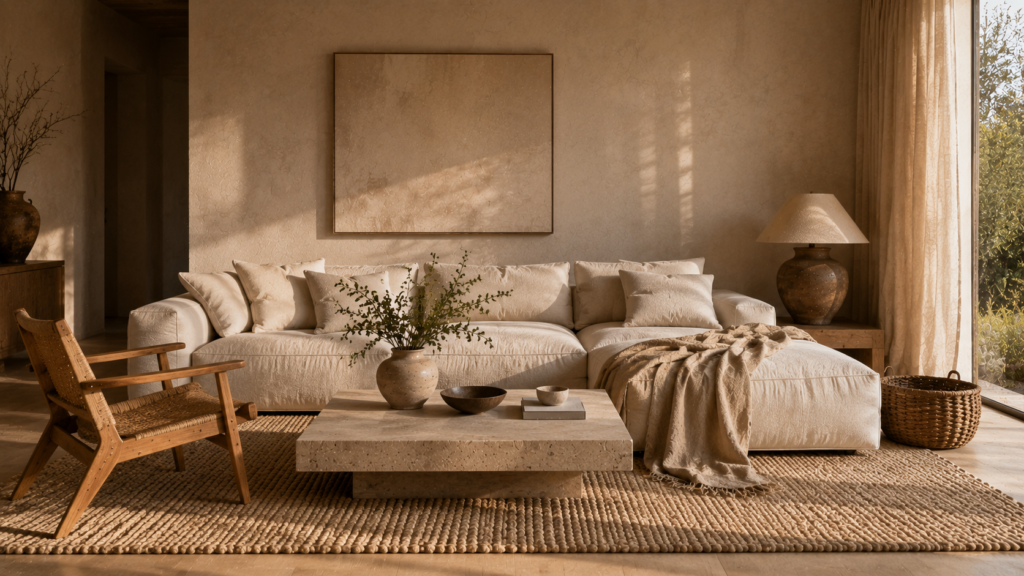
A simple combination might include linen upholstery, a thick wool rug, natural oak, honed stone, a ceramic lamp, and one woven element.
That’s already enough.
You don’t need a gallery wall, ten cushions, decorative trays, and shelves filled with objects to make the room interesting.
If the materials are doing their job, the room can remain remarkably quiet.
And that quietness is part of the luxury.
The Quiet Power of Natural Imperfection
There is a reason natural materials feel so comfortable in minimalist rooms.
They refuse to behave perfectly.
Wood has grain.
Stone has variation.
Linen wrinkles.
Wool changes direction.
Ceramic glaze shifts across a surface.
These inconsistencies create visual life.
In a room built around clean geometry and simple forms, natural imperfection provides balance.
It reminds the eye that not everything needs to be controlled.
And perhaps that is what makes warm minimalism feel so different from the colder interpretation of minimalism that became popular before it.
It isn’t trying to eliminate everything unnecessary.
It’s trying to make the necessary things feel meaningful.
The 10-Minute Texture Edit
You don’t need to redesign your entire home to make it feel more tactile.
Try this instead.
Choose one room.
Remove three decorative objects that don’t contribute anything meaningful.
Then identify the largest smooth surfaces.
Choose one.
Add one natural texture.
A wool rug.
A linen throw.
A woven basket.
A ceramic lamp.
A wooden stool.
A stone tray.
Then stop.
Live with it for a few days.
Notice how the room feels.
Notice how the light moves across the new surface.
Notice what catches your eye.
Notice what you naturally reach toward.
Then decide whether you actually need anything else.
Often, one thoughtful material change can accomplish more than ten decorative additions.
Image 10
A Room Should Feel Good Before It Looks Good
This may be the real lesson behind the touch test.
The best minimalist rooms aren’t designed exclusively for the eye.
They’re designed for everyday life.
You should be able to sit down and feel the softness of the fabric.
Walk across the room and feel the rug beneath your feet.
Rest your hand on the grain of the table.
Pick up a ceramic cup.
Pull a linen throw across your shoulders.
These moments may never appear in an interior photograph.
But they are what make a home feel like a home.
And this is where considered design becomes more than aesthetics.
It becomes experience.
The Havelume Texture Checklist
Before you consider a minimalist room finished, ask yourself:
Does the room contain something soft?
Does it contain something rough or naturally irregular?
Is there visible wood grain?
Is there a mineral material such as stone or ceramic?
Are natural textiles present?
Is there variation between matte and slightly reflective surfaces?
Are the places where you physically interact with the room comfortable?
Is there at least one imperfect or handmade element?
If the answer is yes, the room is probably beginning to develop the tactile depth it needs.
If not, don’t immediately add more.
Look at the materials first.
The Touch Test: A Final Edit
Stand in your doorway again.
Look at the room.
Then imagine closing your eyes.
What would you reach for?
Where would you want to sit?
What would you want beneath your feet?
What would you want your hand to rest on?
That is the touch test.
It is a simple way of asking whether a room has moved beyond looking minimal and started to feel considered.
Because a beautiful home isn’t experienced from a photograph.
It’s experienced through hundreds of tiny interactions.
The chair beneath you.
The rug beneath your feet.
The warmth of the wood.
The softness of the linen.
The irregular edge of a handmade ceramic.
The coolness of stone.
These details may seem small.
Together, they change everything.
The Havelume Takeaway
Warm minimalism isn’t about adding more.
It’s about feeling more from less.
A restrained room can still be soft.
A neutral room can still be rich.
A minimalist room can still feel deeply lived in.
The secret is to stop thinking only in terms of what the eye sees.
Think about what the hand feels.
What the feet experience.
What the body naturally moves toward.
Let wood show its grain.
Let linen crease.
Let stone keep its variation.
Let ceramics show the hand that made them.
Let some things be imperfect.
Because the quietest rooms don’t need more decoration.
They need more texture, more contrast, and more evidence of life.
And sometimes, the best design decision you can make is simply to create a room you want to touch.