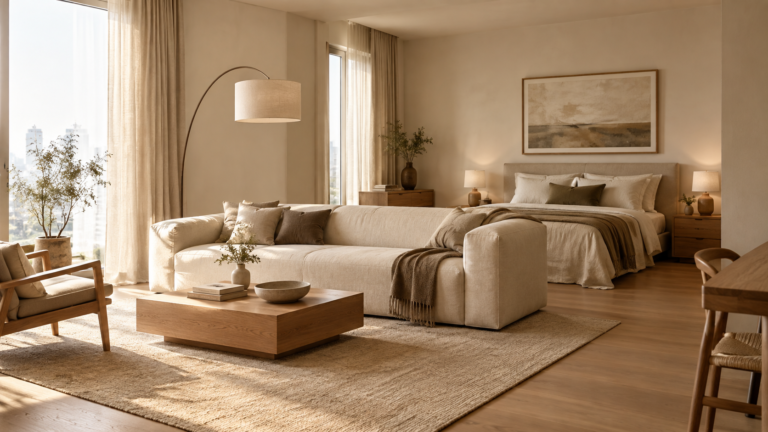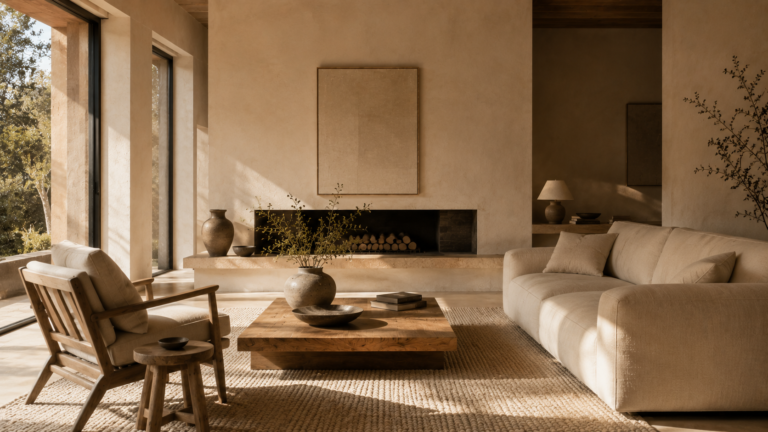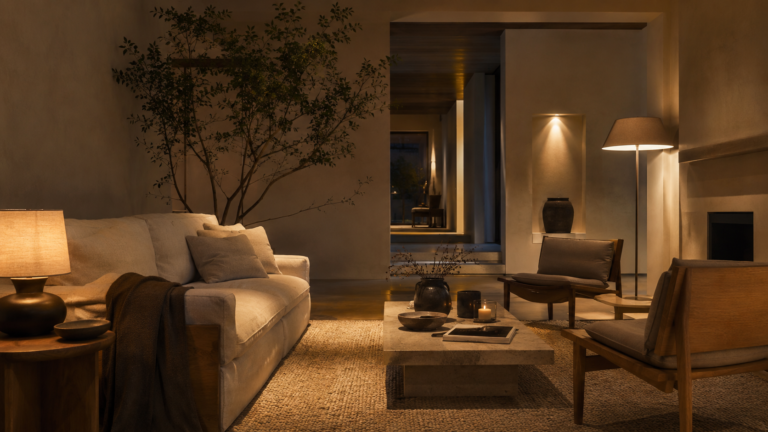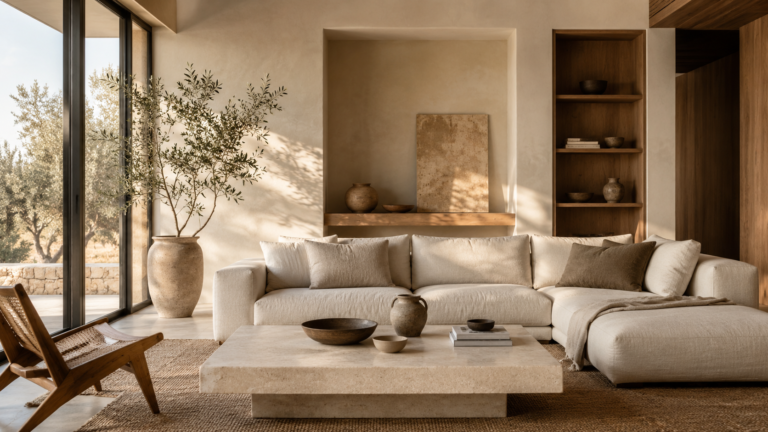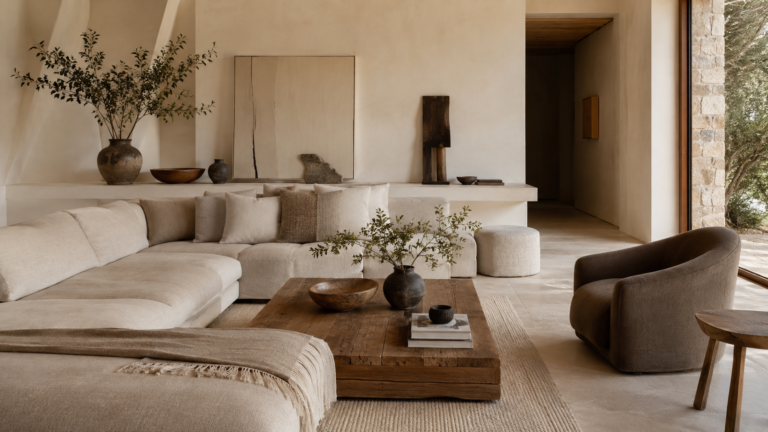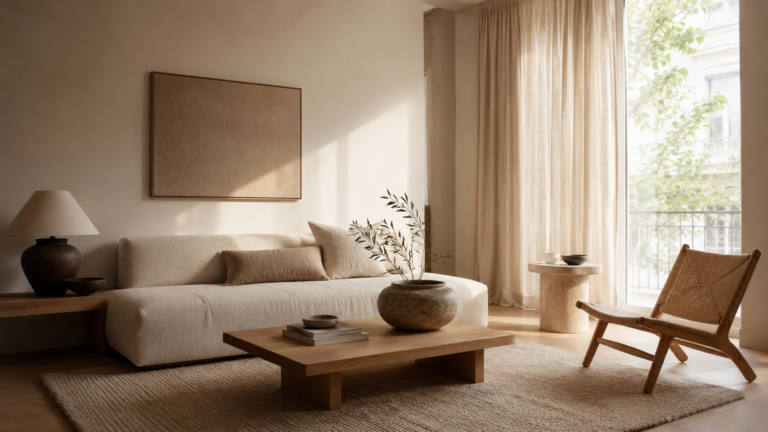
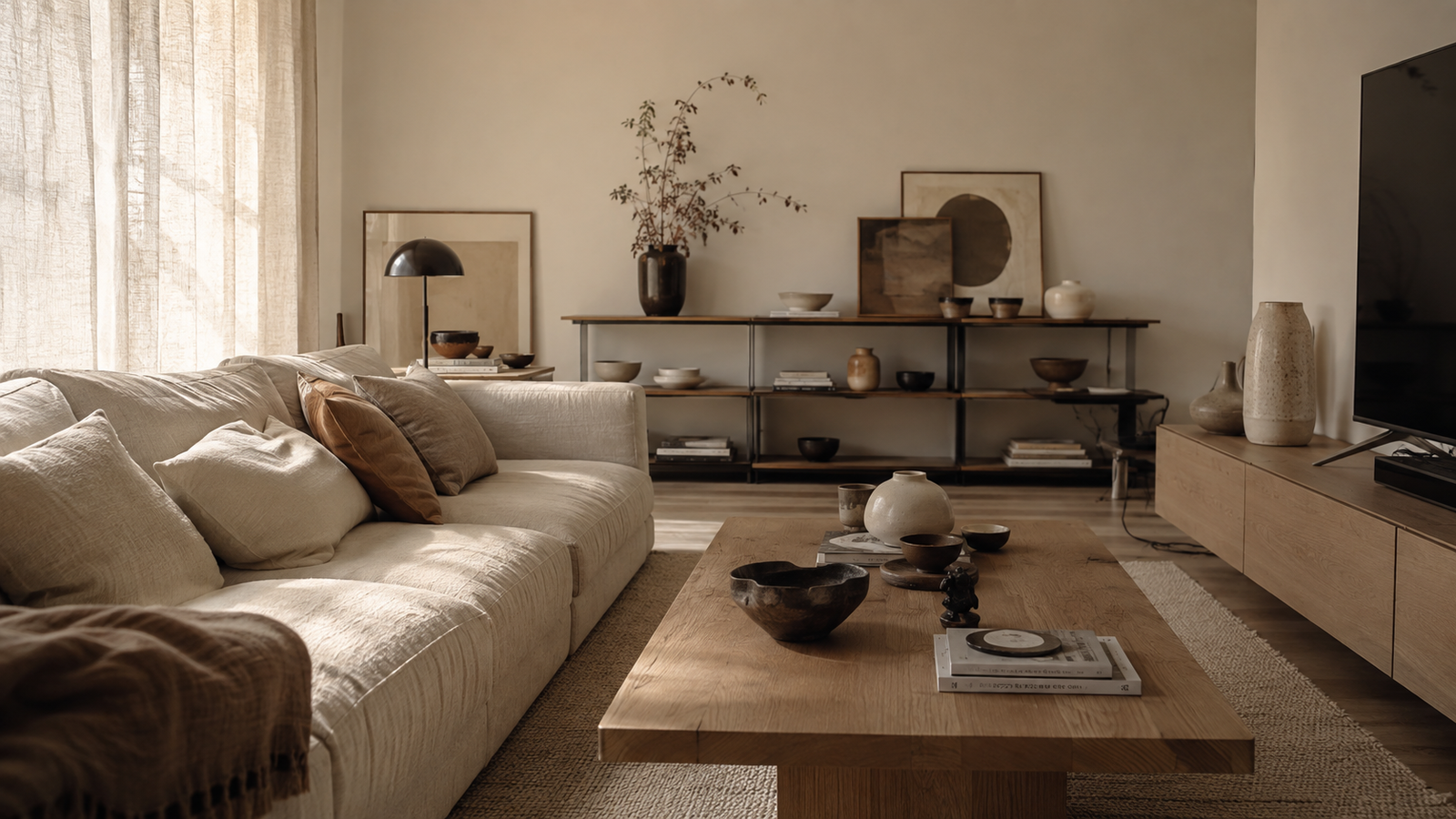
Why Your Minimalist Living Room Still Feels Messy (And How to Fix It)
You removed the clutter. You simplified the furniture. You chose a neutral color palette. You cleared the coffee table.
And somehow, your minimalist living room still looks messy.
If that sounds familiar, you’re probably not doing minimalism wrong.
The problem may be that visual clutter isn’t always caused by having too many things. A room can contain relatively few objects and still feel visually noisy.
A stack of books that doesn’t quite belong. Too many small decorative objects scattered across different surfaces. Open shelving filled with unrelated pieces. Visible cables. Furniture that doesn’t have enough breathing room.
Even a beautifully designed room can feel unsettled when its elements don’t have a clear relationship with one another.
This is why understanding why your minimalist living room looks messy is less about getting rid of everything and more about learning how the eye reads a space.
“Achieving a clutter-free look is the first step toward mastering the anatomy of quiet spaces in your home.”
The goal isn’t to own less simply for the sake of owning less. It’s to make what remains feel intentional.
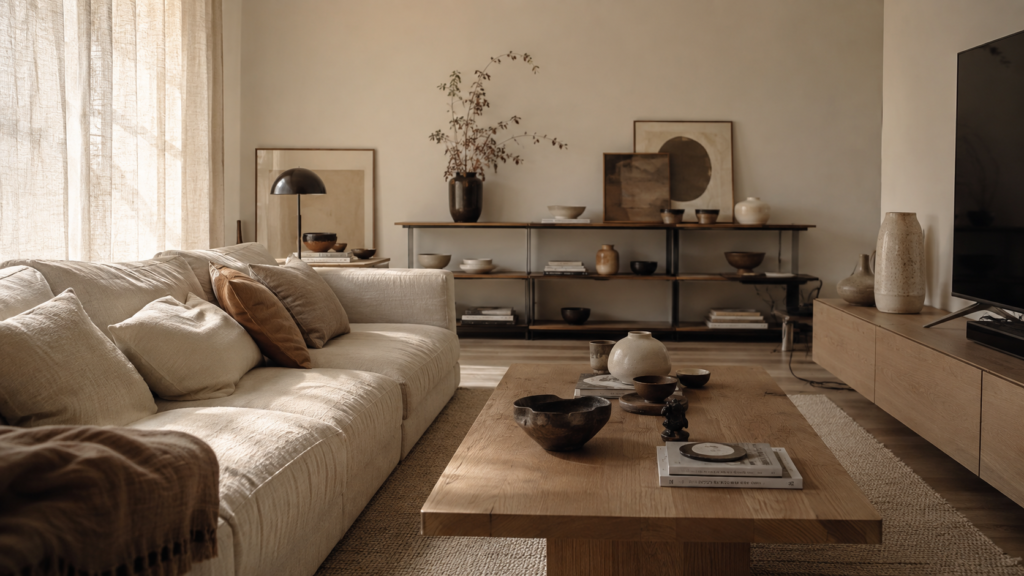
Table of Contents
Why a Minimalist Living Room Can Still Look Messy
The first thing to understand is that physical clutter and visual clutter aren’t exactly the same thing.
Physical clutter is easy to identify. Laundry on the sofa. Papers on the coffee table. Packages on the floor. Objects that simply need to be put away.
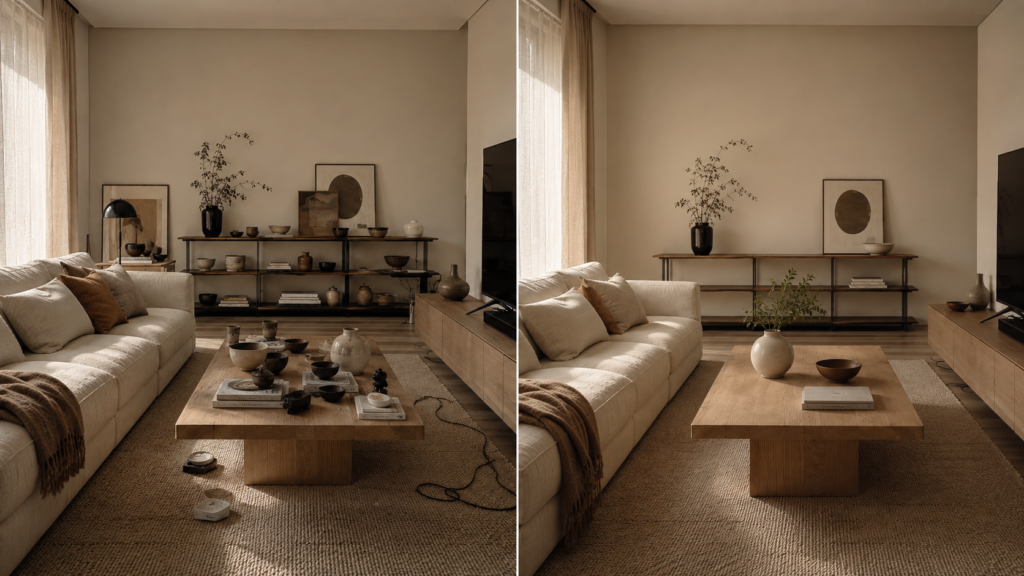
Visual clutter is much more subtle. It happens when your eyes have too many competing places to land. You might have only ten objects in the room, but if every one has a different shape, scale, material, orientation, or visual weight, the space can still feel busy.
And this is particularly noticeable in minimalist interiors. When there are fewer objects, each remaining object becomes more visible. Minimalism doesn’t make editing less important. It makes it more important.
The Difference Between Empty and Calm
One of the easiest reactions to visual clutter is to remove everything. But that can create another problem. The room starts feeling empty rather than calm. Those two things aren’t the same.
An empty room has very little visual information. A calm room has carefully controlled visual information. There can still be books, art, ceramics, textiles, lighting, plants, and personal objects. The difference is that they have relationships with one another.
A calm minimalist living room doesn’t necessarily contain fewer things. It contains fewer competing things.
The First Problem: Too Many Small Objects
One of the most common reasons a minimalist living room looks messy is surprisingly simple. There are too many small things.
A candle. A small vase. A decorative bowl. Three books. A sculpture. Another candle. A tiny plant. A framed photograph. A tray.
Individually, none of these objects is a problem. Together, they can create visual noise. Small objects create more visual interruptions than larger, simpler forms.
This is why replacing several tiny decorative objects with one substantial object can instantly make a room feel calmer. Instead of five small pieces on a coffee table, try one sculptural ceramic, a stack of two or three related books, a low stone bowl, or one organic arrangement.
The goal isn’t emptiness. It’s hierarchy.
The One Anchor Rule
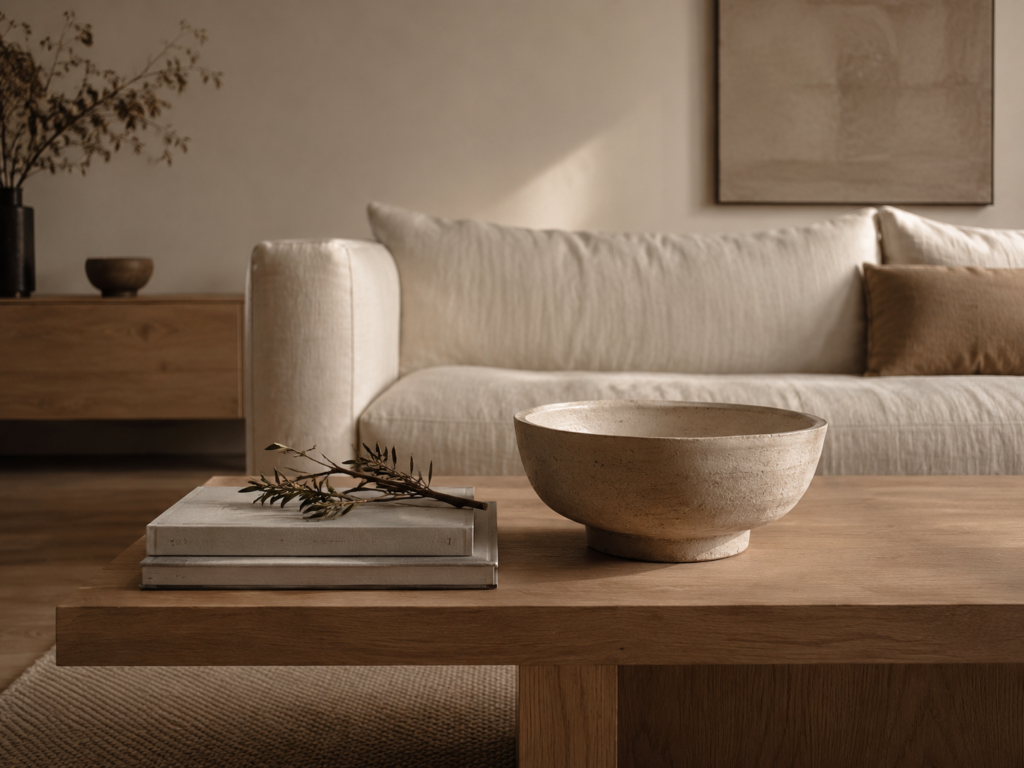
Try giving every major surface one visual anchor. Your coffee table might have a sculptural bowl. Your console might have a lamp. Your side table might have a ceramic vessel. Your media console might have one substantial piece of artwork above it.
This gives the eye a clear starting point. The remaining space can breathe. A room becomes easier to read when the eye understands what matters first.
The Second Problem: Everything Is the Same Size
Another subtle source of visual mess is repetition without hierarchy. Imagine a console displaying six objects that are all roughly the same height. Or a bookshelf where every object is small. Or a coffee table covered with several similarly sized decorative pieces.
Your eye doesn’t know where to look. Good composition needs variation in scale. One large object. One medium object. A few smaller supporting elements. This creates visual rhythm.
The same principle applies to furniture. A large sofa can be balanced by a smaller side table. A substantial coffee table can be paired with a more delicate lamp. A large artwork can anchor a low console. Scale gives the eye a path through the room.
The Third Problem: Your Surfaces Are Too Busy
Look at the surfaces in your living room. Coffee table. Console. Media unit. Side tables. Shelves. Window ledges.
Ask yourself how many of them are carrying decorative objects. If the answer is almost all of them, you’ve probably found part of the problem.
Minimalist interiors need negative space. Not every surface needs to be styled. In fact, leaving some surfaces completely empty can make the decorated surfaces feel more intentional.
Try this. Keep one major surface almost completely clear. Then style another more deliberately. The contrast creates breathing room.
The Fourth Problem: Open Storage Is Doing Too Much
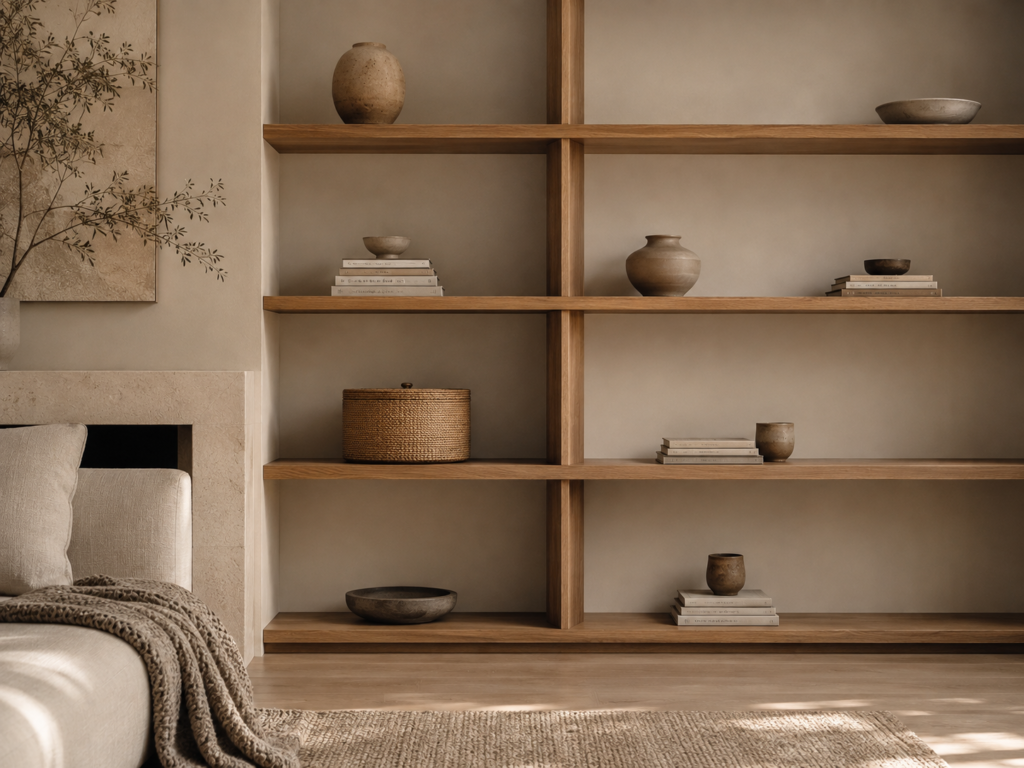
Open shelving can look beautiful in photographs. In everyday life, it can be difficult to maintain. When every shelf contains something, the eye sees a continuous stream of objects. Books, boxes, frames, ceramics, baskets, plants, and decorative pieces.
Even if everything is attractive, the combined effect can feel busy. The solution isn’t necessarily removing the shelving. It’s creating visual pauses.
Leave some sections empty. Group books together. Repeat materials. Use baskets to conceal smaller objects. Give larger objects more breathing room.
Think of shelving as architecture rather than storage. Not every inch needs to be filled.
Group Things Instead of Scattering Them
This is one of the easiest ways to make a minimalist living room feel more organized. Instead of placing similar objects throughout the room, create small intentional groups. Books together. Ceramics together. Remotes together. Small everyday items inside one tray.
Grouping reduces the number of visual decisions the eye has to make. Instead of seeing five unrelated objects, your eye sees one composition.
The Fifth Problem: Your Neutral Palette Is Working Against You
This might sound surprising. After all, neutral interiors are supposed to feel calm. But too many slightly different neutral objects can create visual noise.
Beige vase. Cream candle. Taupe cushion. Gray bowl. White frame. Brown book. Another beige object.
Individually, they’re all quiet. Together, they can become a collection of disconnected tones. This is where the principles of a considered neutral color palette become important.
Choose a controlled family of colors. Warm ivory. Soft beige. Mushroom. Taupe. Natural oak. Walnut. Then repeat those tones intentionally.
The goal isn’t to eliminate variation. It’s to make the variation feel related.
The Sixth Problem: Everything Is Pointing in a Different Direction
Look at the orientation of objects in your living room. Books stacked one way. Frames facing another. Chairs angled slightly differently. Decorative objects turned toward different directions. Cushions arranged without any visual relationship.
Individually, these details may seem insignificant. Collectively, they create visual movement. Sometimes the room doesn’t need fewer objects. It needs fewer directions.
Align your furniture. Straighten major objects. Group similar items. Create parallel lines where possible. Then deliberately introduce one or two softer, organic shapes. The result feels more controlled without becoming rigid.
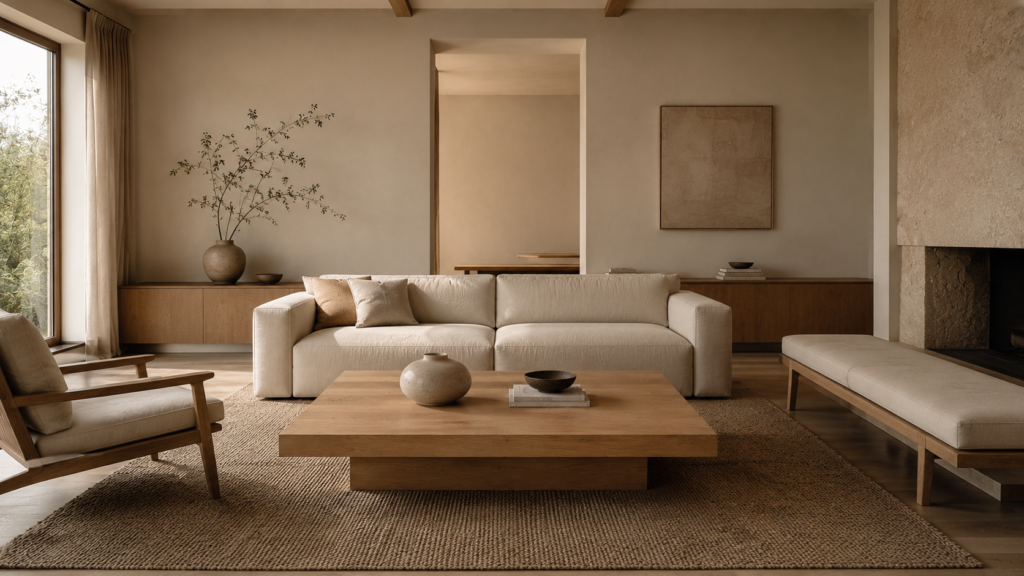
The Seventh Problem: Your Furniture Is Too Close Together
Sometimes what feels like clutter isn’t clutter at all. It’s poor spacing.
A sofa pushed too close to a coffee table. An armchair almost touching the sofa. A side table squeezed into a corner. A floor lamp competing with furniture.
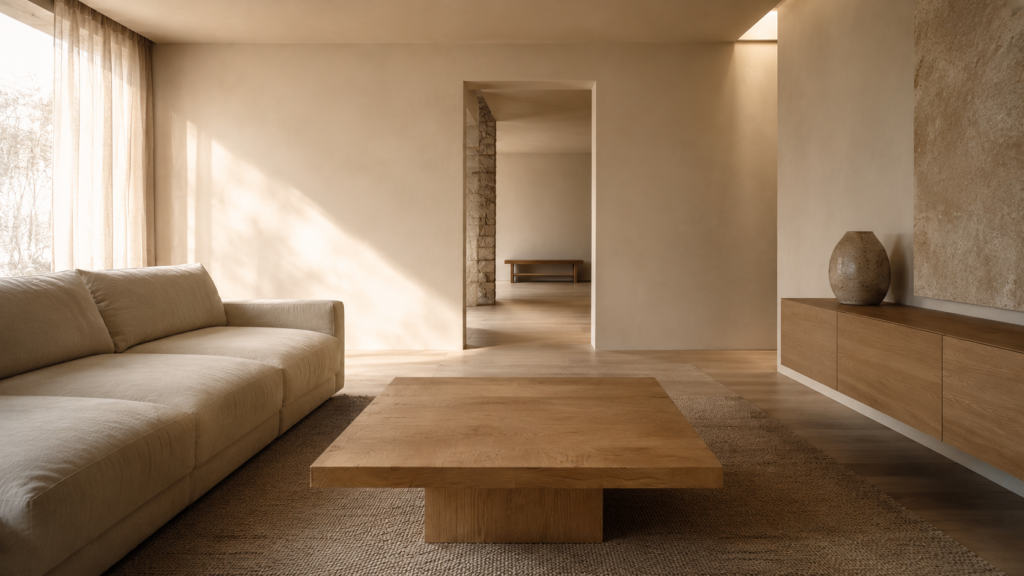
When furniture doesn’t have enough breathing room, the entire room feels compressed. Minimalist interiors depend heavily on negative space.
Try moving furniture slightly apart. You may discover that the room immediately feels more spacious without removing a single object. Give each major piece enough room to exist.
The Breathing Room Test
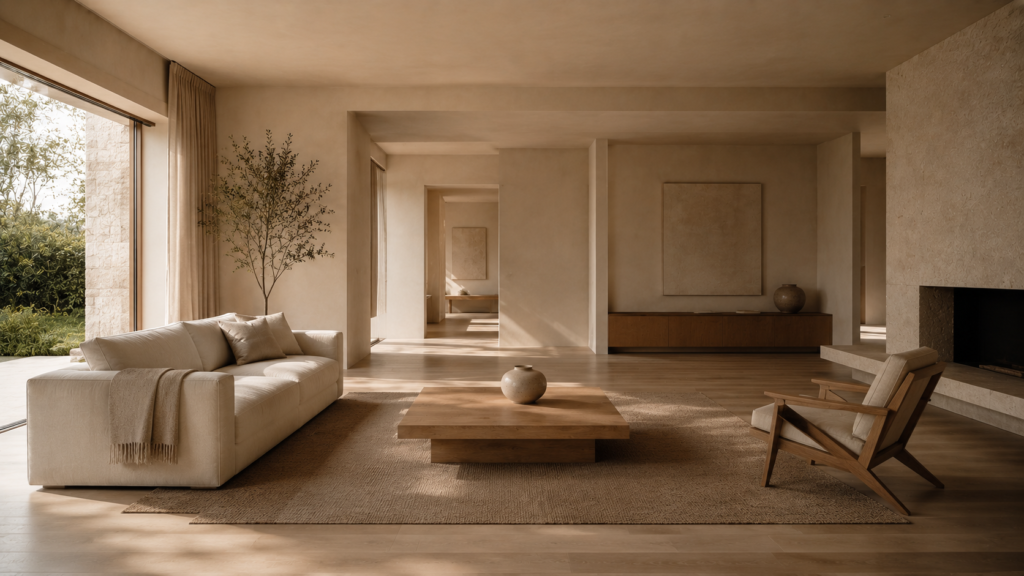
Stand in the doorway. Look at the floor. Can you visually follow a path through the room? Or do furniture legs, baskets, stools, and decorative objects interrupt that path?
Now look at the space between furniture. Does each piece have enough room around it?
A calm room usually has clear visual pathways. You shouldn’t have to mentally navigate around every object before your eye reaches the window.
The Eighth Problem: Technology Is Creating Hidden Visual Noise
This is one of the least glamorous parts of minimalist design. Cables. Remote controls. Routers. Game consoles. Speakers. Chargers. Power strips. Television equipment.
These objects can undermine an otherwise carefully considered room. The good news is that you don’t need to hide technology completely. You simply need to manage it.
Route cables along furniture. Use concealed cable management where possible. Group remotes in one tray. Store controllers together. Choose furniture that can conceal electronics.
If your television dominates the room, consider balancing it with surrounding architecture, art, or cabinetry rather than allowing it to become an isolated black rectangle. Technology should serve the room. It shouldn’t visually control it.
The Ninth Problem: Your Decor Doesn’t Have a Focal Point
A minimalist room still needs somewhere for the eye to rest. Without a focal point, attention moves from object to object. That movement can feel like mess.
Your focal point could be a large piece of artwork, a fireplace, a sculptural light, a beautiful window, a substantial coffee table, an architectural wall, or a large plant.
Once you establish the focal point, secondary objects become supporting characters. This creates hierarchy. And hierarchy is one of the foundations of visual calm.
The Tenth Problem: You’re Decorating Every Corner
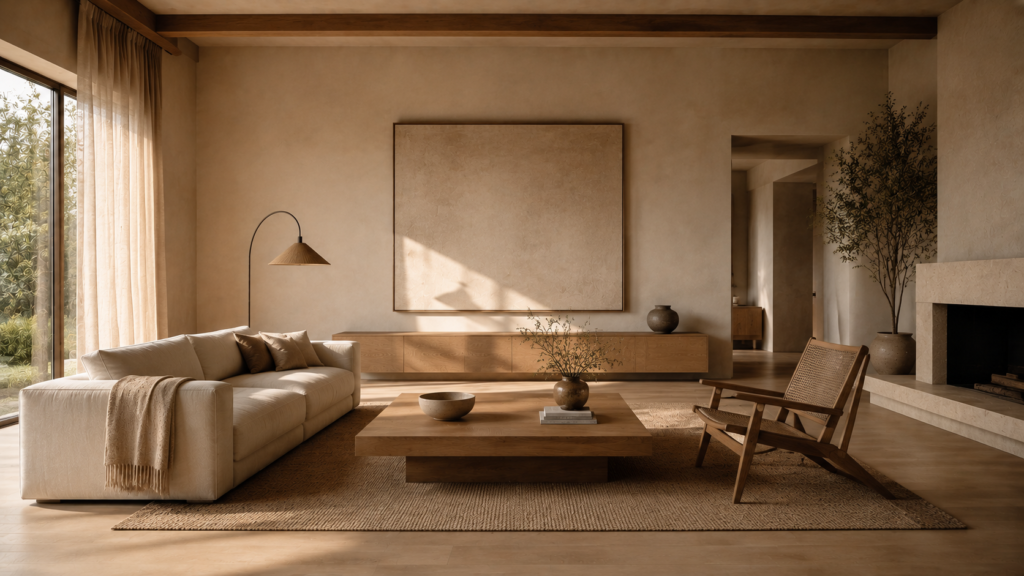
This is one of the hardest habits to break. An empty corner can feel uncomfortable. So we put something there. A plant. A basket. A stool. A floor lamp. A sculpture. Then another object appears beside it. Eventually, every corner has a purpose.
But not every corner needs one. Empty space is not wasted space. It helps the objects around it feel more important.
Try removing one item from each corner. Then live with the room for a few days. You may discover that the empty space was exactly what the room needed.
The Five Object Edit
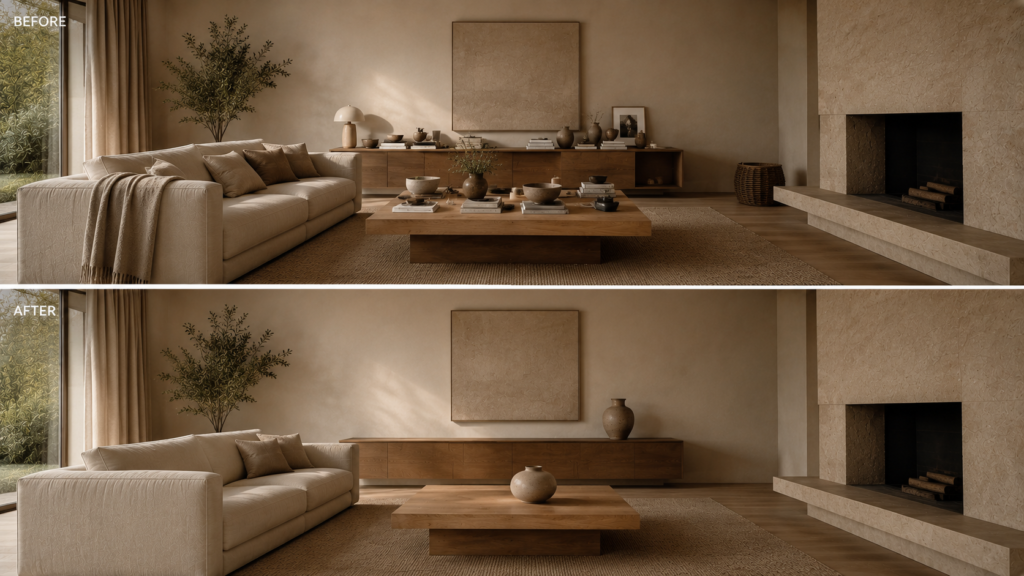
If your living room still feels visually busy, try this. Choose five objects that aren’t essential. Remove them. Don’t replace them. Live with the room for 48 hours.
Then ask. Does the room feel calmer? Does the architecture feel more visible? Does the furniture feel more intentional? Do the remaining objects stand out more?
If yes, you’ve learned something important. The room didn’t need more styling. It needed more editing.
The Rule of Visual Weight
Not every object takes up the same amount of visual space. A dark object usually feels heavier than a pale one. A large object feels heavier than a small one. A complex shape feels heavier than a simple one. A highly textured object can attract more attention than a smooth surface.
This means you can have only a few objects and still create imbalance. For example, a dark walnut cabinet on one side of the room may visually dominate several pale ceramic objects on the other.
The solution isn’t necessarily adding more objects to the lighter side. You might simply need to reposition what you already have. Think about visual weight, not just physical weight.
Repeat Before You Add
Here’s one of the most useful principles for a minimalist living room. Before introducing something new, look for something you already own that can repeat its quality.
If you want more warmth, perhaps the existing oak can be echoed with a wooden bowl. If you want more softness, perhaps your linen sofa needs a wool throw rather than another decorative cushion. If you want more texture, perhaps a woven basket can replace several smaller accessories.
Repetition creates cohesion. Constant novelty creates noise. A sophisticated room usually repeats a small number of materials, colors, and shapes.
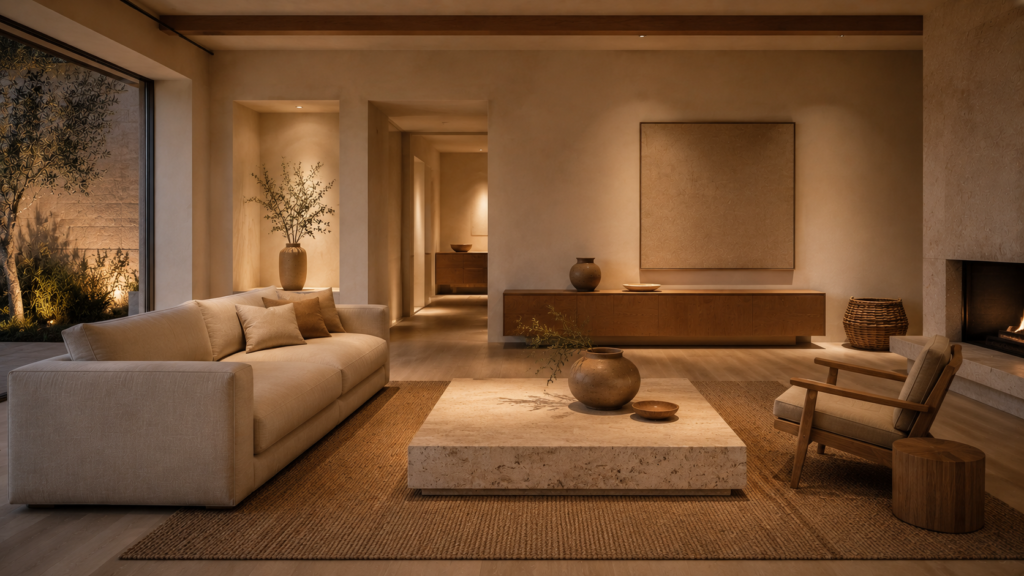
A Minimalist Living Room Should Feel Edited, Not Empty
This is perhaps the most important distinction. A beautifully minimalist living room doesn’t look like nobody lives there. It looks like someone has decided what deserves to remain visible.
There can be books. There can be blankets. There can be photographs. There can be ceramics. There can be plants. There can be technology. There can even be a little everyday mess.
The difference is that the room has a visual hierarchy. Some things are important. Some things support them. Some things are hidden. And some things simply don’t need to be there. That’s what creates calm.
A 15 Minute Living Room Reset
You don’t need to spend an entire weekend reorganizing the room. Try this quick reset.
First, clear every surface. Don’t organize yet. Just clear.
Second, return only the objects you actually use or genuinely love.
Third, group similar items.
Fourth, hide cables and everyday technology.
Fifth, remove anything that feels visually repetitive.
Sixth, step back and look at the room from the doorway.
Finally, ask yourself what is the first thing you notice. What is the second. Where does your eye stop.
If the answer is everywhere, keep editing. If your eye naturally moves toward one or two focal points, you’re getting closer.
What to Remove Before You Buy Anything New
Before adding another basket, tray, vase, or decorative object, ask yourself these questions.
Can I solve this problem by removing something. Can I group these objects. Can I hide them. Can I repeat something I already own. Can I leave this surface empty. Can I create more breathing room instead.
This mindset can completely change how you approach minimalist interior design. You stop decorating problems. You start solving them.
The Havelume Visual Clutter Checklist
Before considering your minimalist living room finished, look at these areas.
Coffee table. Is there one clear focal point.
Console. Is the surface intentionally edited.
Open shelving. Are there enough empty spaces between groups.
Furniture. Does every major piece have breathing room.
Floor. Are there unnecessary objects interrupting visual pathways.
Technology. Are cables, remotes, and devices visually controlled.
Color. Do the objects belong to a cohesive palette.
Texture. Is there enough variation without excessive visual activity.
“Swap out cold synthetic surfaces by bringing organic textures and tactile comfort into minimalist rooms through elements like linen, wood, and stone.”
Scale. Are different sizes creating hierarchy.
Corners. Does every corner really need something.
Focal point. Does the room have somewhere for the eye to rest.
Why Your Minimalist Living Room Still Feels Messy: The Final Edit
Stand in the doorway. Don’t start moving furniture yet. Just look.
What catches your eye first. Then what. Then what.
If your attention jumps rapidly around the room, you’ve probably got a hierarchy problem. If your eye settles naturally on the architecture, artwork, furniture, or another intentional focal point, the room is beginning to feel calmer.
Now look at everything around that focal point. Does it support the composition. Or compete with it.
This is the real work of minimalist design. Not removing everything. Not buying matching furniture. Not making your home look like a showroom. It’s learning to recognize what deserves attention.
The Havelume Takeaway
A minimalist living room can still feel messy when there is too much visual competition. Too many small objects. Too many exposed surfaces. Too little negative space. Poor furniture spacing. Competing neutral tones. Uncontrolled technology. Repeated shapes. Lack of hierarchy.
The solution isn’t always to own less. Sometimes it’s to arrange better.
Group instead of scatter. Repeat instead of constantly introduce. Anchor instead of decorate every surface. Hide what doesn’t need to be seen. Give furniture room to breathe. Let some corners remain empty.
And most importantly, remember that minimalism isn’t about creating a room with nothing in it. It’s about creating a room where everything that remains has a reason to be there.
A calm home isn’t necessarily an empty home. It’s an edited one. And when the visual noise disappears, the things you chose to keep finally have room to speak.