Light That Breathes: Ditching Overhead Glare for Layered Ambiance
A room can look beautiful all day and somehow lose its magic the moment the sun goes down.
The furniture hasn’t changed.
The colors haven’t changed.
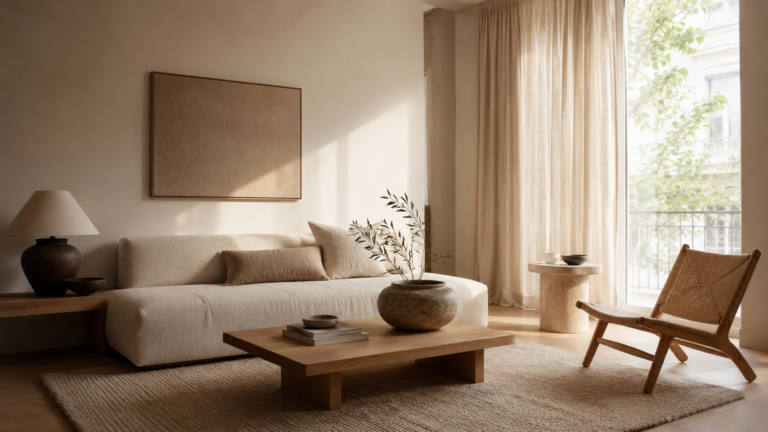
The linen sofa is still there. The oak still looks warm. The stone coffee table still has that beautiful variation across its surface.
And yet, you switch on one bright ceiling light and suddenly the room feels… different.
Flatter.
Colder.
More functional than inviting.
The problem may not be your furniture at all.
It may be the way you’re lighting it.
If The Anatomy of Quiet Spaces was about what a minimalist room needs, this one is about what that same room feels like after dark — and why good layered lighting matters just as much as good furniture.
For years, overhead lighting has been treated as the default solution to darkness. One switch, one bright source, one evenly illuminated room.
It’s practical.
But atmosphere rarely comes from practicality alone.
“Harsh overhead lighting can instantly ruin the anatomy of quiet spaces, turning a carefully styled room into a sterile environment.”
A beautifully considered home needs places for light to gather, places for shadows to settle, and corners that don’t need to be completely illuminated.
This is where layered lighting changes everything.
Instead of asking, “How bright should this room be?”
Try asking:
“Where should the light live?”
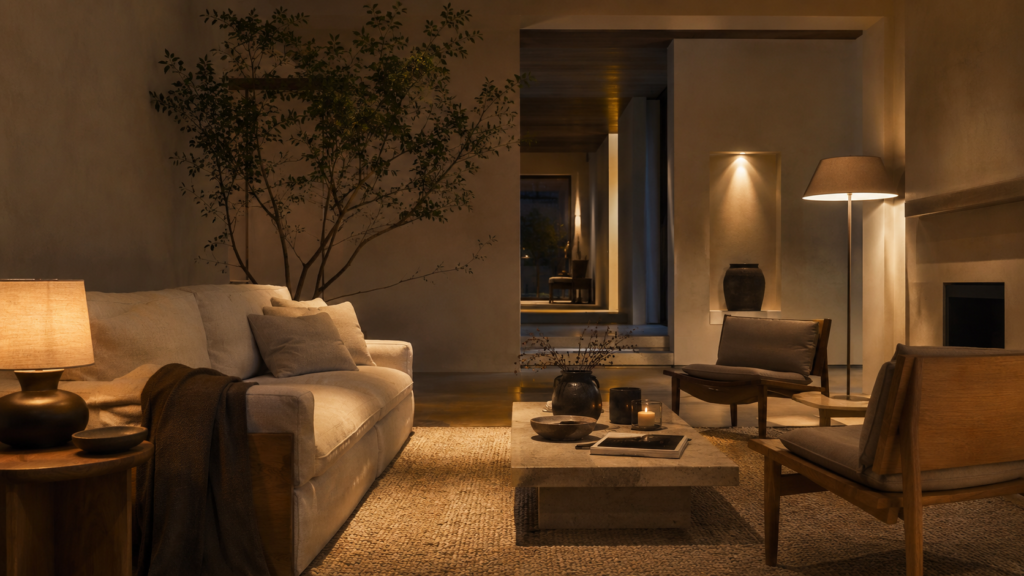
Table of Contents
The Problem With One Bright Light
Walk into almost any room and there’s a familiar sequence.
You enter.
You flip the switch.
The ceiling light comes on.
Everything becomes visible.
Technically, the room is well lit.
But visibility and atmosphere aren’t the same thing.
A single overhead fixture tends to spread light across the room with very little hierarchy. The sofa, artwork, walls, floor, and corners all receive attention at roughly the same time.
Nothing particularly glows.
Nothing really recedes.
The room loses some of the depth it had during daylight.
And this is especially noticeable in minimalist interiors.
When you have fewer decorative objects, materials and light have to do more of the visual work. A beautiful piece of natural oak can look rich and dimensional under soft side lighting but surprisingly flat beneath a bright ceiling fixture.
The solution isn’t necessarily to remove overhead lighting.
It’s to stop asking one fixture to do everything.
Use the ceiling light when you need general visibility.
Then let smaller sources take over when you want the room to feel beautiful.
That simple shift is the foundation of layered lighting design.
The Havelume Principle Don’t light everything equally. Give the eye somewhere to go.
Why Layered Lighting Makes a Room Feel Better
Think about natural daylight.
It isn’t uniform.
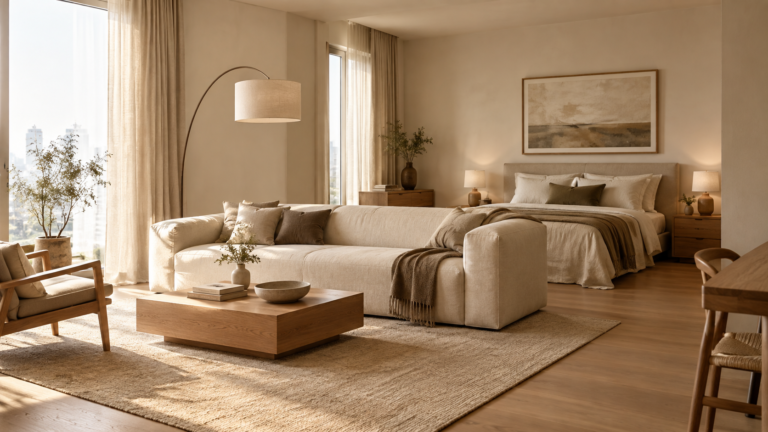
Light enters through a window and changes as it travels across the room. One wall might be bright while another sits quietly in shadow. Furniture interrupts the light. Textured surfaces catch it differently from smooth ones.
“Warm, indirect lighting only works its magic when it hits physical depth—learn how bringing organic textures and tactile comfort into minimalist rooms catches and diffuses that ambient glow.”
Those variations are what give a room depth.
After sunset, artificial lighting can recreate some of that feeling.
Instead of relying on one dominant source, you create several smaller sources, each with a different purpose.
One provides general illumination.
Another helps you read.
Another highlights artwork.
Another simply creates warmth.
The result can actually be less bright while feeling much more comfortable.
That’s the interesting thing about good ambient lighting design.
More light doesn’t always create more atmosphere.
Sometimes better atmosphere comes from using less light, but placing it more thoughtfully.
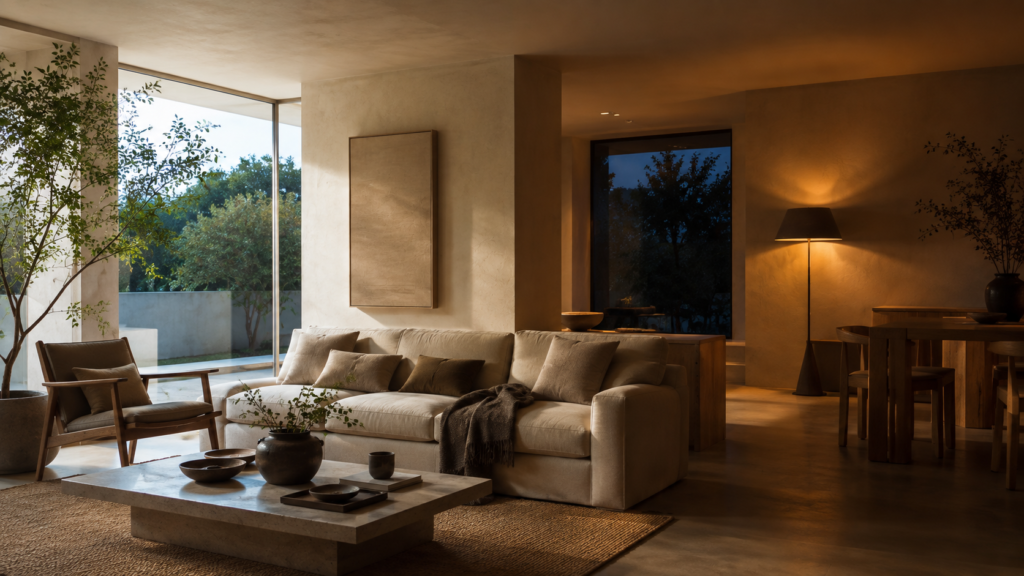
The Four Layers of Interior Lighting
You don’t need an elaborate smart-home system or a dozen designer fixtures to create beautiful ambient lighting.
Start with four basic layers:
Ambient light Task light Accent light Decorative light
Once you understand what each layer does, lighting an interior becomes much easier.
Ambient Light
Ambient lighting provides the overall illumination of a room.
It allows you to move around comfortably and see the space as a whole.
But ambient light doesn’t have to come from a single ceiling fixture.
It can come from wall lights, floor lamps, table lamps, recessed lighting, or even light reflected softly from a nearby wall.
The goal is comfortable visibility rather than maximum brightness.
Task Light
Task lighting exists for specific activities.
Reading.
Cooking.
Working.
Eating.
Getting ready.
A reading chair needs a reading lamp.
A kitchen counter needs useful illumination.
A dining table benefits from a pendant or fixture that brings light down toward the table.
Task lighting makes a room functional without forcing the entire space to be brightly illuminated.
Accent Light
Accent lighting gives the eye something to notice.
It might highlight:
A piece of artwork A textured plaster wall A plant An architectural detail A beautiful shelf A collection of ceramics
The important word here is “accent.”
You don’t need to highlight everything.
Choose a few elements worth noticing.
Decorative Light
Then there is lighting that simply contributes to the mood.
A sculptural table lamp.
A small ceramic lamp.
A softly glowing pendant.
A beautiful wall sconce.
These fixtures can be functional, but they also become part of the interior itself.
In a warm minimalist home, that matters.
Your lighting shouldn’t feel like equipment added after the room was designed.
It should feel like part of the design language.
Start With Ambient Light
Ambient light is the background layer.
But here’s where many people go wrong.
They assume the background needs to be bright.
It doesn’t.
The goal is to create enough illumination to comfortably inhabit the room while leaving space for other lights to create atmosphere.
Imagine two living rooms.
In the first, one ceiling fixture is switched on at full brightness.
Everything is equally visible.
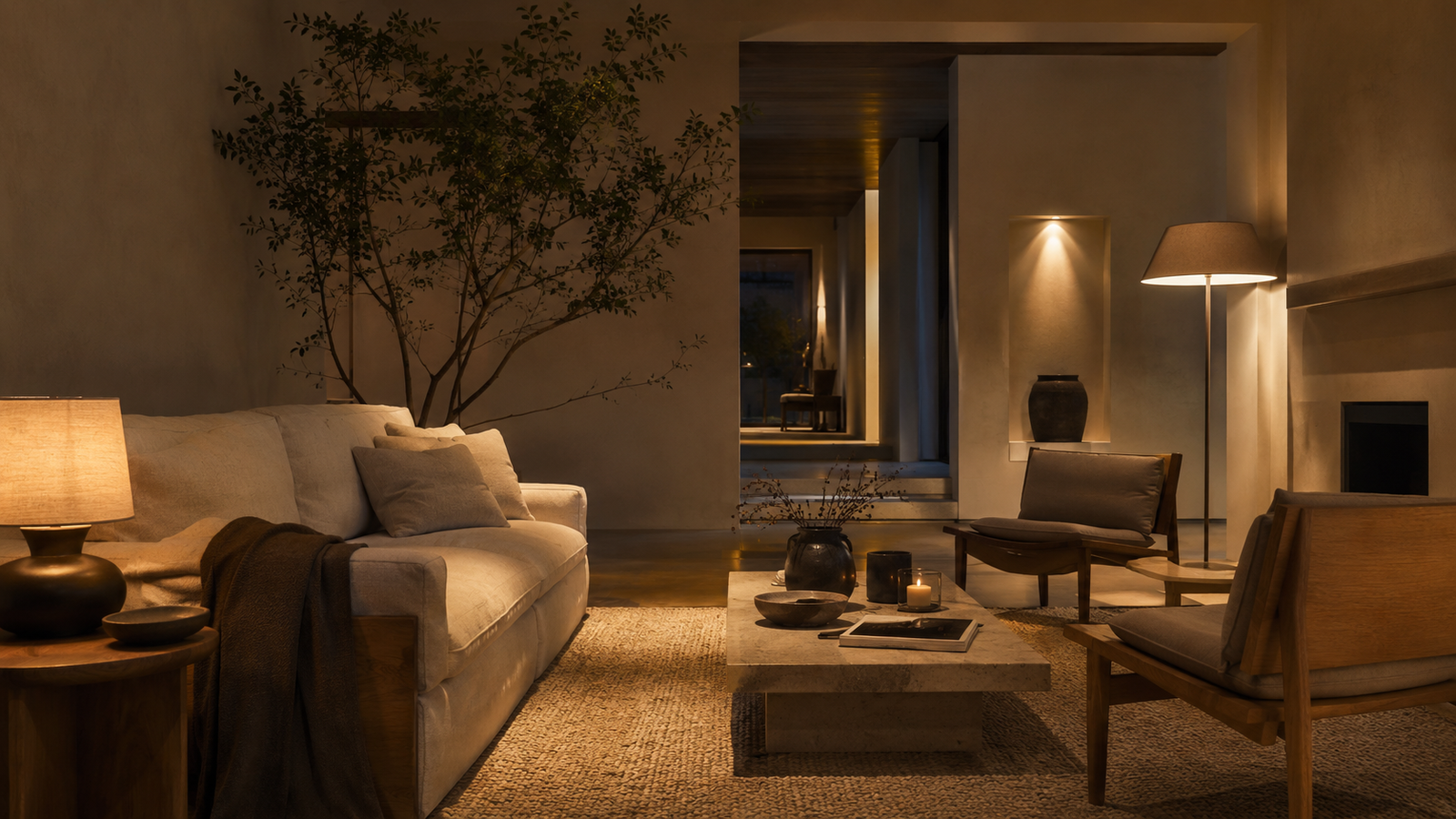
In the second, the overhead fixture is dimmed. A floor lamp glows beside the sofa. A small table lamp illuminates a nearby console. A subtle wall light catches the texture of the plaster.
The second room contains more individual light sources.
Yet it feels calmer.
Why?
Because every source has a role.
The light isn’t competing.
It’s layering.
A useful rule to remember:
If every light is equally bright, none of them feels particularly important.
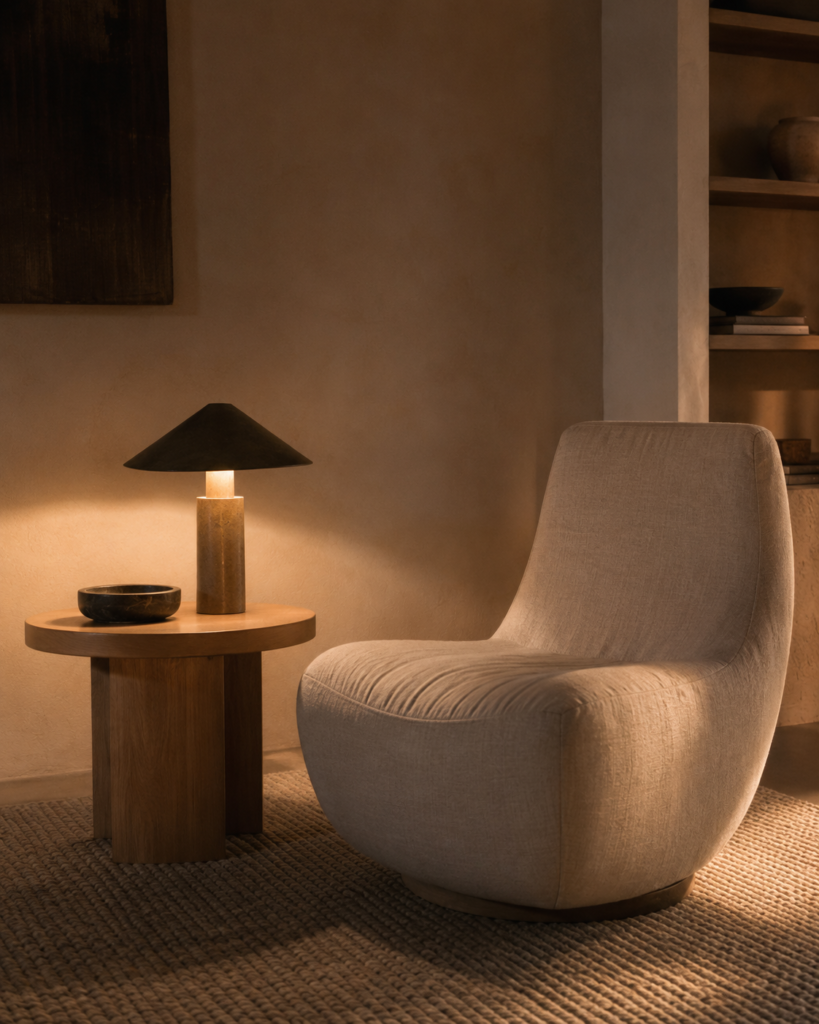
Add Task Lighting Where Life Happens
Good lighting design begins with understanding how you actually use a room.
Forget the furniture plan for a moment.
Think about your evening.
Where do you read?
Where do you sit and talk?
Where do you eat?
Where do you work?
Where do you make coffee?
Where do you relax?
Those activities should influence where your light goes.
A reading chair should have its own comfortable pool of light.
A dining table should feel intimate rather than brightly illuminated from every direction.
A bedside lamp should provide enough light to read without turning the entire bedroom into a workspace.
A desk should be properly illuminated without flooding the surrounding room.
This is where lighting becomes quietly intelligent.
You don’t notice that the lighting has been “designed.”
You simply notice that the room works.
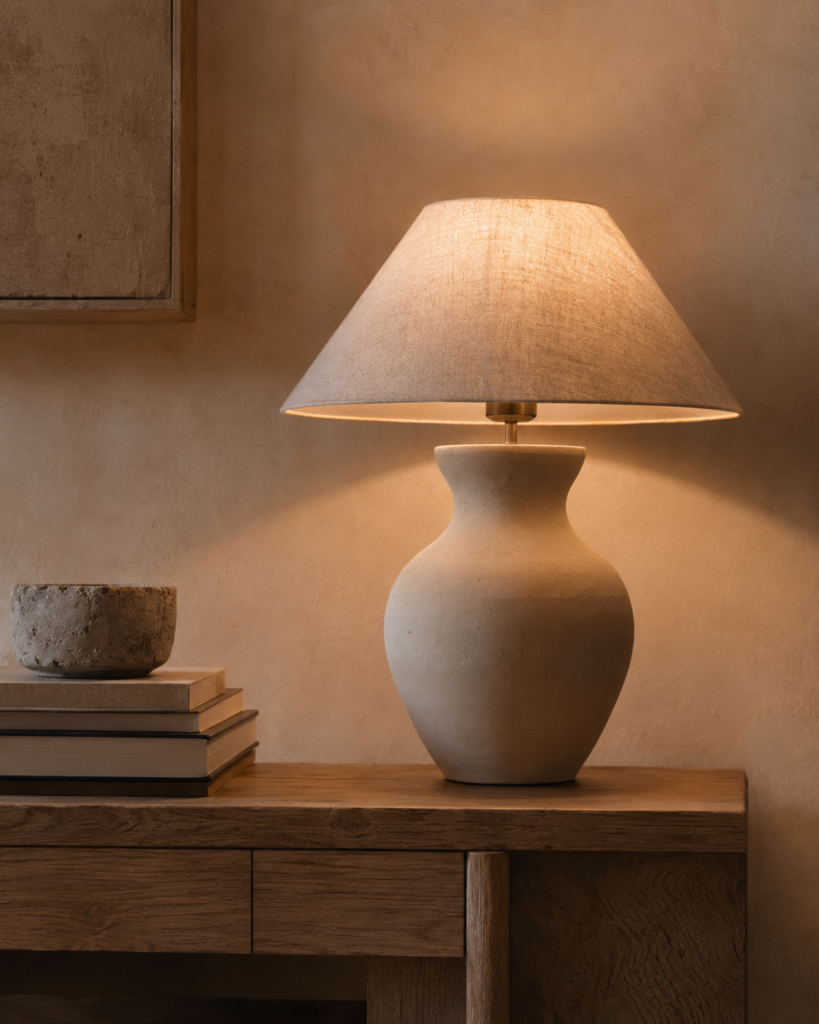
Use Accent Lighting to Create Depth
Accent lighting is where an interior begins to develop character after dark.
A narrow beam of light across textured plaster can reveal the imperfections that make the material beautiful.
A picture light can give artwork a quiet presence.
A small light beneath a shelf can create depth within an otherwise dark recess.
A floor light positioned near a plant can turn its leaves into delicate shadows against the wall.
None of these lights need to be powerful.
In fact, they shouldn’t be.
The goal isn’t to illuminate every detail.
It’s to create moments.
This is particularly effective in minimalist interior design because restraint makes each visual decision more noticeable.
When there are fewer objects, a carefully illuminated object becomes much more meaningful.
Let Lamps Become Part of the Interior
A lamp is more than a bulb with a shade around it.
It has shape.
Scale.
Material.
Texture.
Color.
And presence.
That means choosing lamps deserves almost as much attention as choosing a chair or side table.
A linen shade can soften a room filled with hard architectural surfaces.
A ceramic base can introduce craftsmanship.
A stone lamp can echo a limestone coffee table.
A dark metal fixture can create quiet contrast against warm plaster.
In a warm minimalist interior, lighting can become another way to introduce natural materials without adding unnecessary decoration.
Think of your lamps as part of the room’s material palette.
Not an afterthought.
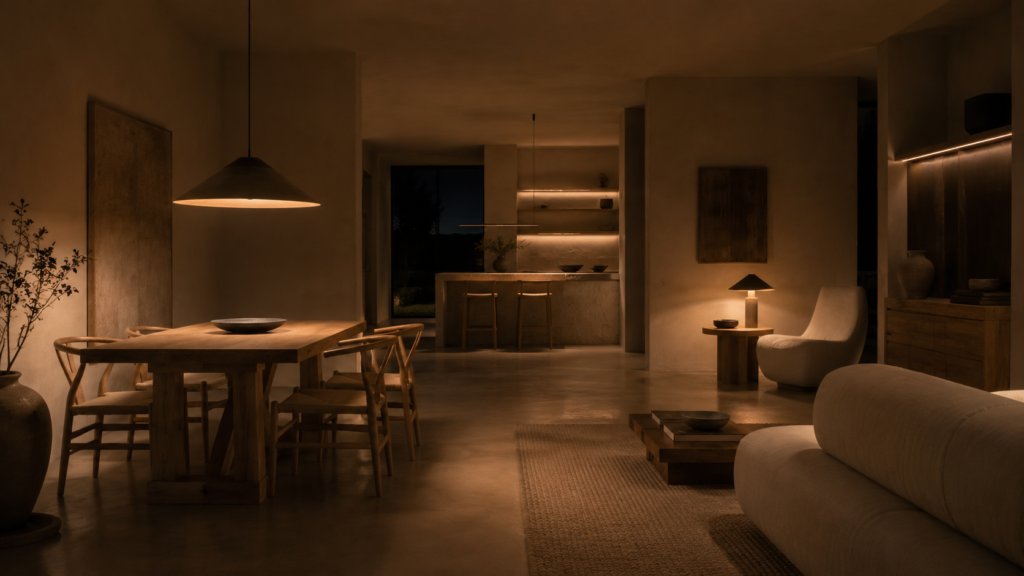
Choose Warm Light Without Making Everything Orange
“Warm lighting” is often misunderstood.
The goal isn’t to turn your living room orange.
The goal is to create a comfortable visual temperature that works with the materials and colors already in the space.
For residential interiors, warmer color temperatures often create a softer evening atmosphere than very cool white light.
But don’t choose bulbs in isolation.
Look at the room as a whole.
Warm light behaves differently against:
White paint Cream plaster Oak Walnut Stone Dark green Terracotta Linen
If your walls are already warm, extremely warm bulbs may become excessive.
If your room contains cooler materials, a warmer light source may help balance them.
The best lighting temperature is ultimately the one that makes the room’s materials look beautiful and allows you to feel comfortable in the space.
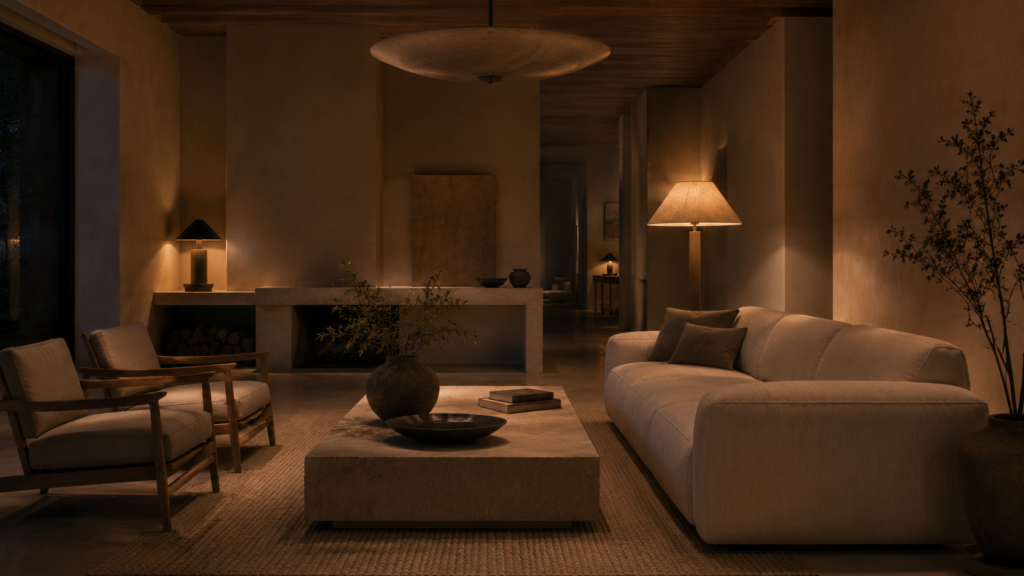
Create Pools of Light, Not Walls of Light
One of the most beautiful things about evening lighting is the idea of a pool.
A pool of light is a small, intentional area of illumination surrounded by quieter space.
A chair beside a lamp.
A dining table beneath a pendant.
A console illuminated by a small wall light.
A reading corner glowing softly while the rest of the room remains subdued.
These pools create rhythm.
The eye moves from one to another.
The room feels larger because everything isn’t competing at the same visual intensity.
This is especially effective in open-plan homes.
Instead of trying to illuminate the entire space uniformly, create distinct zones.
The dining area can have its own glow.
The seating area can have another.
A kitchen island can have a more functional light.
The room remains connected, but each area develops its own atmosphere.
Let Some Corners Stay Dark
This may be the most counterintuitive lighting principle of all.
You don’t have to illuminate every corner.
In fact, you probably shouldn’t.
Darkness creates contrast.
It gives brighter areas more importance.
A slightly shadowed corner can make the illuminated portion of a room feel warmer.
A dim hallway can make the living room beyond it feel more inviting.
A dark wall behind a lamp can make the lamp’s glow feel richer.
We tend to think of darkness as a lighting problem.
In considered interiors, darkness can be part of the composition.
Not every corner needs to be seen.
Some corners are there to make the light feel more beautiful.
Rethink the Overhead Fixture
This doesn’t mean removing every ceiling light.
Sometimes you need it.
Sometimes you even want it.
The better question is:
Does the ceiling fixture need to be the main character?
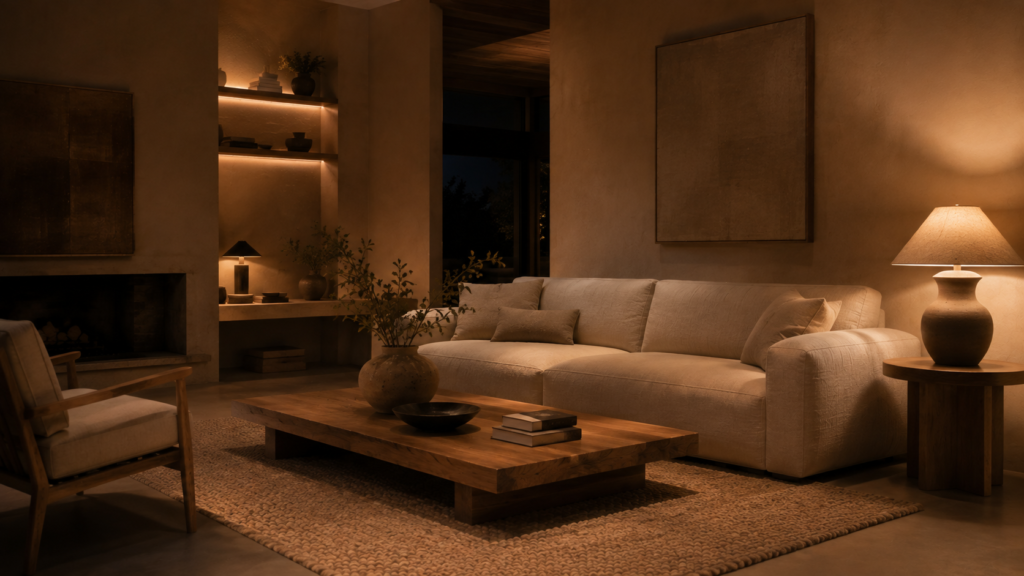
For everyday evenings, try dimming the overhead light and switching on two or three smaller sources instead.
A floor lamp near the sofa.
A table lamp on a console.
A pendant above the dining table.
A small wall light near artwork.
Suddenly, the room has hierarchy.
If you are renovating, consider installing dimmers wherever possible. They allow the same fixture to perform different roles throughout the day.
Bright enough for cleaning.
Softer for dinner.
Gentler for late evening.
One room can have several moods without changing anything else.
A Simple Evening Lighting Ritual
Lighting can become part of your daily routine.
Instead of switching every light on as soon as the sun disappears, allow the room to transition.
Start with the remaining daylight.
Then turn on one ambient source.
Later, add a task light where you’re actually spending time.
As evening deepens, allow smaller lamps to become more noticeable.
Eventually, the room becomes a collection of gentle pools rather than one uniformly illuminated space.
This gradual transition feels natural because it follows the way daylight itself changes.
The room doesn’t suddenly become “night.”
It slowly becomes evening.
And that small change can affect how you experience the space.
The 10-Minute Lighting Edit
You don’t need to redesign your entire lighting system tonight.
Try this instead.
Turn off every light in the room.
Stand in the doorway.
Let your eyes adjust.
Now switch on the overhead fixture.
Notice what happens.
Everything is equally visible.
Now turn it off.
Switch on your smallest lamp.
Then another.
Then another.
Notice where your eye moves.
Which corner suddenly feels inviting?
Which surface looks beautiful?
Which area still feels too dark?
Which light feels too harsh?
You have just discovered your room’s lighting hierarchy.
Now make one change.
Move a lamp closer to where you actually sit.
Lower a shade.
Angle a floor lamp toward a wall instead of directly into the room.
Replace one harsh bulb.
Add a dimmer if your fixture allows it.
You don’t need ten new lights.
You need to understand the ones you already have.
What Good Ambient Lighting Should Feel Like
Good ambient lighting is difficult to describe because you often notice it only when it is wrong.
It shouldn’t make you squint.
It shouldn’t flatten the room.
It shouldn’t create distracting glare.
It shouldn’t make every surface look identical.
And it shouldn’t feel like you’re sitting beneath a spotlight.
Instead, good ambient lighting should make the room feel easy to inhabit.
You should be able to read.
Talk.
Eat.
Rest.
Move around.
And simply be there.
The best lighting design often disappears into the experience of the room.
You don’t think:
“What an excellent lighting scheme.”
You think:
“I want to stay here.”
The Lighting Materials That Change Everything
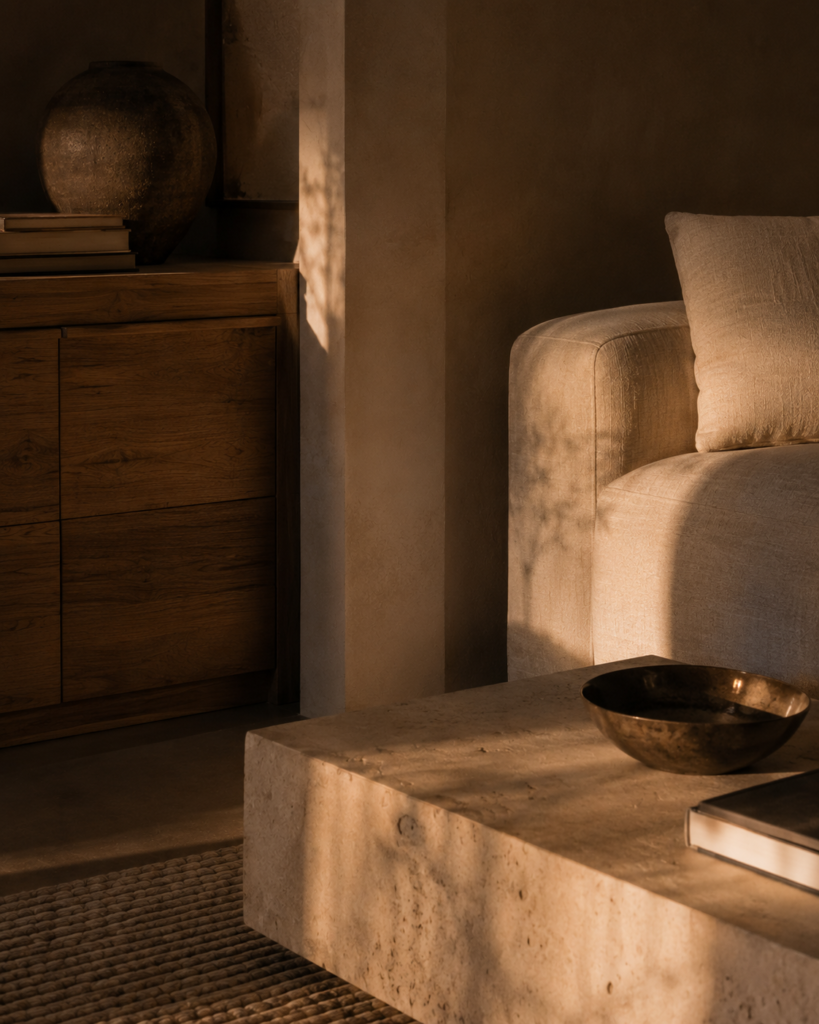
Light doesn’t exist separately from the materials around it.
A warm bulb hitting glossy white paint behaves differently from the same bulb hitting textured plaster.
A linen lampshade diffuses light.
A stone surface reflects it subtly.
Wood absorbs some of its intensity and makes it feel grounded.
Glass can spread it.
Metal can reflect it.
This is why material selection and lighting design should be considered together.
If you’re creating a warm minimalist interior, think about the relationship between the light source and the surface it touches.
Ask:
What does the light reveal?
What does it soften?
What does it hide?
Where does it create shadow?
That is where atmosphere begins.
A Room Should Have More Than One Mood
One of the hidden benefits of layered lighting is flexibility.
The same room can feel completely different at different times.
Morning can be bright and clear.
Late afternoon can feel soft and natural.
Dinner can become intimate.
Reading can become focused.
Late evening can become almost shadowy.
You don’t need separate rooms for separate moods.
You need lighting that can adapt.
This is particularly valuable in minimalist interiors because the furniture and architecture tend to be restrained.
Lighting becomes one of the easiest ways to change the emotional character of the space without introducing visual clutter.
A Simple Layered Lighting Formula
If you’re unsure where to begin, try this:
One general light source One task light where you actually spend time One accent light that highlights something beautiful One small decorative lamp that adds warmth
You may not need all four in every room.
But thinking in layers gives you a better starting point than simply asking:
“How many lights do I need?”
Instead ask:
“What does this room need to help me experience it differently?”
That question leads to better lighting.
The Havelume Lighting Checklist
Before you finish designing a room, look at these seven things:
Natural daylight Ambient illumination Task lighting Accent lighting Warmth and color temperature Shadows and darker areas Dimmers or adjustable light where possible
If all seven have been considered, your room will likely feel much more intentional after sunset.
And remember:
More illumination is not necessarily more atmosphere.
Sometimes the most beautiful thing you can do with light is leave something in shadow.
The Room After Sunset
During the day, architecture does much of the work.
Windows frame the sky.
Sunlight moves across the floor.
Materials reveal their natural variation.
At night, you have to recreate some of that depth yourself.
That is why lighting deserves more thought than simply choosing a beautiful fixture.
The fixture is only the beginning.
The real design happens in the relationship between light and shadow, brightness and darkness, material and reflection.
A warm minimalist room shouldn’t look exactly the same at 8 p.m. as it does at 2 p.m.
It should evolve.
It should soften.
It should breathe.
And perhaps that is the real purpose of layered lighting.
Not to make a room brighter.
But to make it feel more alive.
The Havelume Takeaway
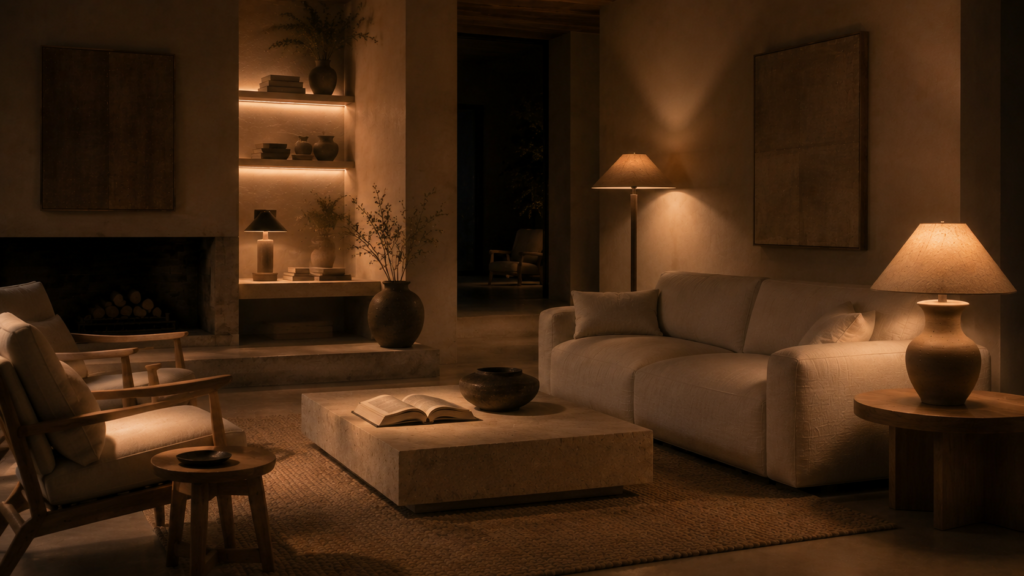
Good lighting doesn’t compete with a room.
It reveals it.
It makes natural materials feel richer.
It gives architecture depth.
It creates intimacy without adding clutter.
And it allows a minimalist home to have something a single overhead light rarely provides:
A sense of rhythm.
So before replacing your furniture, adding more decor, or wondering why your living room feels cold at night, look up.
Then look down.
Look toward the corners.
Notice where the shadows fall.
Notice where the eye naturally wants to rest.
You may not need more light.
You may simply need to let the light breathe.